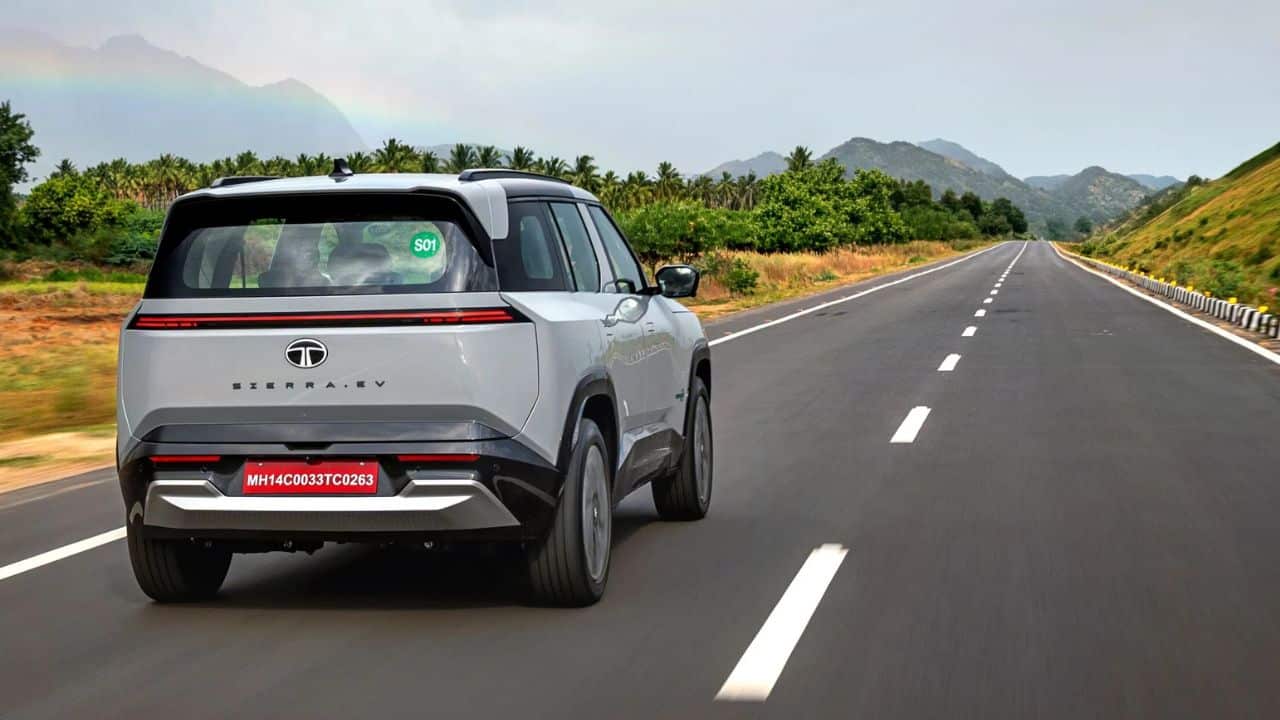

Motor output on the Sierra EV isn’t as simple as bigger battery, more power. Tata has paired its two battery packs with different motor configurations, and the numbers don’t scale the way most buyers instinctively expect. This guide breaks down exactly what power and torque you get on each variant, how quick the Sierra EV actually is, and what that means for how it feels to drive.
Motor & Power Output by Variant
| Configuration | Battery | Motors | Power | Torque |
|---|---|---|---|---|
| RWD | 63 kWh | 1 (rear) | 238 PS | 315 Nm |
| RWD | 75 kWh | 1 (rear) | 209 PS | 315 Nm |
| AWD (QWD) | 75 kWh | 2 (front + rear) | 209 PS rear + 140 PS front | 504 Nm combined |
The detail that trips up most buyers comparing these numbers: the smaller 63 kWh battery produces more power, 238 PS, than the single-motor 75 kWh variant’s 209 PS. Torque is identical between the two single-motor configurations at 315 Nm. So within the RWD lineup, choosing the bigger battery doesn’t buy you more performance, it buys you more range, and if anything, you’re giving up a modest amount of peak power to get it. This is specific to how Tata has tuned each motor for its respective battery pack, not a universal EV rule, and it’s worth keeping in mind if outright acceleration matters more to you than outright range on a single-motor Sierra EV.
The AWD Empowered A variant is the clear performance outlier in the lineup. Its dual-motor setup, a 209 PS unit driving the rear wheels and a 140 PS unit driving the front, works together to deliver 504 Nm of combined torque, meaningfully more than either single-motor configuration. This is where Tata has concentrated the Sierra EV’s genuine performance credentials.
0-100 kmph and Acceleration
Tata has officially confirmed a 0-100 kmph time of 5.8 seconds for the AWD Empowered A variant, a genuinely quick figure for an SUV of this size and one of the stronger numbers in its price bracket. That acceleration comes from the combination of instant electric torque delivery, standard across every EV regardless of configuration, and the AWD system’s ability to put power down through all four wheels simultaneously rather than relying on the rear wheels alone to manage 504 Nm without wheelspin.
🚀 Join Our Tech Community!
Get the latest news, updates, and tech trends delivered straight to your phone. Never miss an update!
Tata has not officially published a 0-100 kmph figure for the RWD variants. Based on the power and torque figures involved, RWD variants should still feel notably brisk off the line by conventional SUV standards, EVs generally deliver stronger low-speed acceleration than equivalent petrol engines even at lower power outputs, but they’re clearly tuned for smooth, confident everyday driving rather than outright performance in the way the AWD variant is.
Why Electric Motors Feel Different From Petrol Engines
For buyers new to EVs, it’s worth understanding why these power and torque figures translate into a driving feel that’s genuinely different from a petrol SUV with similar numbers on paper. Electric motors deliver their maximum torque almost instantly from a standstill, with no need to build revs the way a combustion engine does. This is why EVs, including the Sierra EV, tend to feel notably quick off the line even at power outputs that wouldn’t be particularly remarkable on a petrol spec sheet.
The trade-off is that this instant response requires more deliberate throttle control, particularly on the AWD variant with its 504 Nm on tap. New EV drivers coming from a petrol or diesel background often find themselves accelerating more sharply than intended in the first few days of ownership, simply because there’s no engine lag cushioning the initial throttle input the way there typically is with combustion power delivery.
Boost Mode
The Sierra EV includes a Boost mode, designed to provide extra power delivery during overtakes or situations requiring a sudden burst of acceleration, such as merging onto a highway or clearing a slower vehicle quickly on a two-lane road. This kind of mode is common across modern EVs and typically works by allowing brief access to power beyond the motor’s standard operating parameters for a limited duration, though the exact mechanism and any variant-specific availability should be confirmed against Tata’s official documentation.
Driving Modes and Regenerative Braking
Beyond outright motor output, the Sierra EV’s driving character is also shaped by regenerative braking, the system that recovers energy during deceleration by running the electric motor in reverse, feeding power back into the battery while also helping slow the vehicle. This reduces wear on the conventional friction brakes and improves overall efficiency, both genuinely useful in stop-start Indian city traffic where regenerative braking gets frequent use.
The strength of regenerative braking and the availability of specific driving modes for adjusting it are details that vary meaningfully between EV models. Buyers coming from a petrol background should expect a genuine adjustment period getting used to how strongly the car decelerates when lifting off the accelerator, particularly if the Sierra EV offers a strong one-pedal-style regenerative setting.
How Performance Differs Between RWD and AWD in Real Driving
Beyond the headline numbers, the practical difference between RWD and AWD Sierra EV variants comes down to how power actually reaches the road. The RWD variants, with all torque going through the rear wheels alone, are tuned for smooth, predictable everyday driving rather than aggressive performance, well suited to daily commuting and highway cruising without demanding much adjustment from the driver.
The AWD variant’s ability to split power across both axles means it can deploy its higher 504 Nm output more effectively without the wheelspin or traction loss a rear-wheel-drive-only system might experience trying to put down the same torque figure. This is a meaningful part of why the AWD variant achieves its quicker 5.8-second 0-100 kmph time, it’s not just more torque, it’s more torque that the drivetrain can actually use efficiently.
Frequently Asked Questions
Which Tata Sierra EV variant has the most power?
The 63 kWh RWD variant produces the most single-motor power at 238 PS, though the AWD Empowered A variant produces the most combined power and torque overall through its dual-motor setup.
What is the 0-100 kmph time of the Tata Sierra EV?
The AWD Empowered A variant has a confirmed 0-100 kmph time of 5.8 seconds. Tata has not officially published a figure for the RWD variants.
Does the bigger battery on the Tata Sierra EV mean more power?
No. The single-motor 75 kWh variant actually produces less power (209 PS) than the smaller 63 kWh variant (238 PS), with identical torque of 315 Nm on both.
Is the Tata Sierra EV quick off the line?
Yes, relative to its power figures. Like all EVs, the Sierra EV delivers maximum torque instantly from a standstill, giving it a notably brisk feel off the line even on the lower-power RWD variants, ahead of what similar power figures would suggest on a petrol engine.