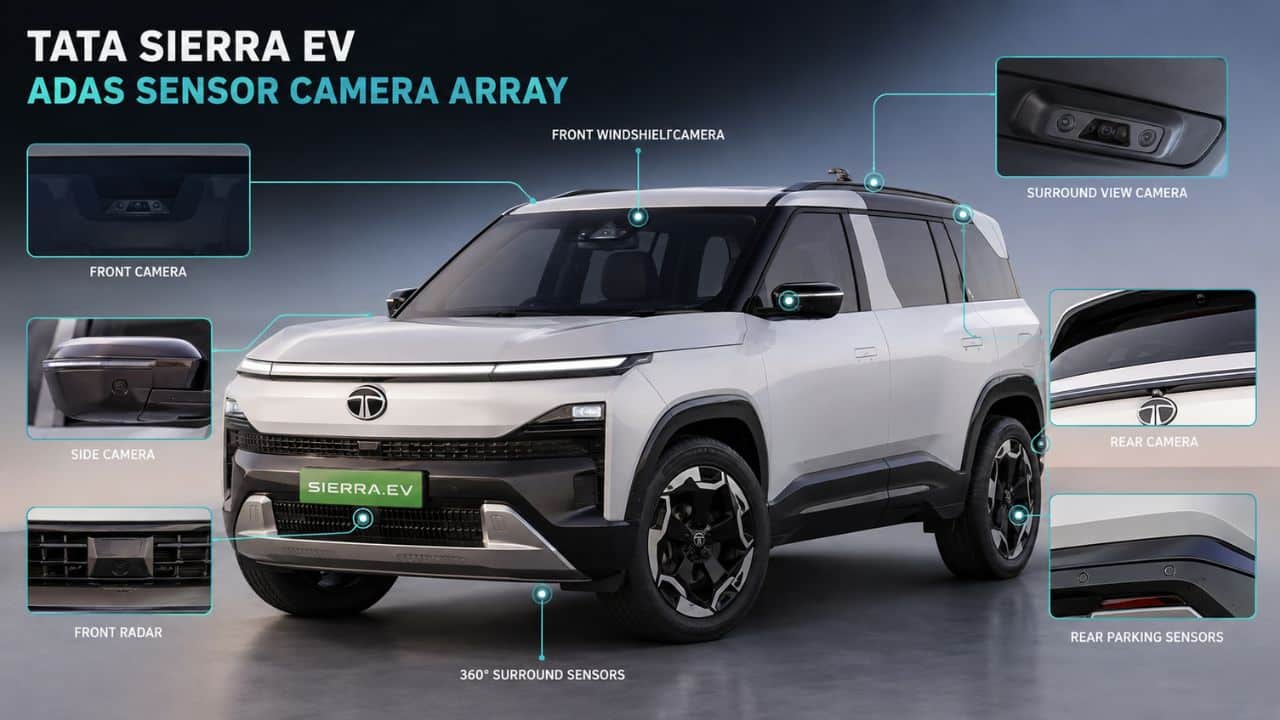

Tata has confirmed the Sierra EV comes with a Level 2+ Advanced Driver Assistance System offering 22 driver assistance functions, built around the vehicle’s camera, radar and ultrasonic sensor array. That’s a genuinely large number of individual functions for a car in this price bracket, but a raw count doesn’t tell you much on its own. This guide breaks down what these functions actually do in practice, grouped by what they’re designed to protect you against, so the number becomes something more useful than a spec-sheet bullet point.
What Level 2+ ADAS Actually Means
Before getting into individual functions, it’s worth being clear about what Level 2+ ADAS does and doesn’t do. Level 2 means the system can control both steering and speed simultaneously under specific conditions, such as maintaining lane position while also managing following distance on a highway. The “+” typically signals a broader or more integrated feature set than a baseline Level 2 system, without crossing into Level 3, where the vehicle could handle certain driving tasks without the driver monitoring the road at all times.
None of this makes the Sierra EV self-driving. Every function in this list is designed to assist an attentive driver, not replace one. Tata, like every manufacturer offering ADAS, is explicit that these systems support the driver rather than substitute for their judgement, and Indian road conditions in particular, inconsistent lane markings, unpredictable pedestrian movement, mixed traffic, mean driver attention remains essential regardless of how capable the system feels in ideal conditions.
The Functions, Grouped by What They Protect Against
Tata’s 22-function ADAS architecture, as configured across its recent L2+ platform rollouts including the Sierra lineup, generally groups into a few practical categories. (Wait for Official Report)
🚀 Join Our Tech Community!
Get the latest news, updates, and tech trends delivered straight to your phone. Never miss an update!
Collision Avoidance and Braking
Forward Collision Warning (FCW) alerts the driver when the system detects a high risk of collision with a vehicle, pedestrian, or cyclist ahead, giving a critical extra second or two of reaction time.
Autonomous Emergency Braking (AEB) takes this a step further, automatically applying the brakes if the driver doesn’t react in time to a detected collision risk. This is one of the most consequential functions in the entire suite, since it can prevent or meaningfully reduce the severity of a front-end collision even when the driver is genuinely distracted.
Rear Collision Warning (RCW) performs a similar function for the rear of the vehicle, alerting the driver to a fast-approaching vehicle from behind that risks a rear-end collision.
Lane and Position Monitoring
Lane Departure Warning (LDW) alerts the driver if the vehicle drifts out of its lane without an indicator being used, a common cause of accidents linked to fatigue or momentary distraction.
Lane Keep Assist (LKA) goes further than a warning, applying gentle steering correction to help guide the vehicle back toward the center of its lane if it starts to drift.
Lane Centering System (LCS) works continuously to keep the vehicle centered within its lane during sustained driving, particularly useful on long highway stretches where maintaining perfect lane position manually over hours becomes genuinely tiring.
Blind Spot and Lane Change Safety
Blind Spot Detection (BSD) monitors the areas alongside and slightly behind the vehicle that mirrors alone don’t fully cover, warning the driver of a vehicle present before a lane change is attempted.
Blind Spot View Monitor (BSM) takes this further by displaying a live camera feed of the blind spot area on the driver’s screen when an indicator is activated, giving a direct visual check rather than just a warning light.
Lane Change Alert (LCA) provides an additional layer of warning specifically during an active lane-change manoeuvre if a vehicle is detected in the target lane.
Parking and Low-Speed Manoeuvring
Rear Cross Traffic Alert (RCTA) warns the driver of approaching vehicles from either side when reversing out of a parking space, a genuinely common cause of low-speed accidents in crowded parking areas and driveways with limited visibility.
Door Open Alert (DOA) notifies occupants of an approaching vehicle or cyclist from behind before they open a door to exit, protecting against dooring incidents, particularly relevant in dense Indian roadside parking situations.
Speed and Following Distance Management
Adaptive Cruise Control (ACC) with Stop & Go automatically adjusts the vehicle’s speed to maintain a safe following distance from the car ahead, including the ability to bring the vehicle to a complete stop and resume moving in heavy traffic, genuinely useful given how much time Indian commuters spend in stop-start conditions.
Intelligent Speed Assist (ISA), typically available in both traffic-sign-reading (TSP) and map-based forms, helps the driver stay within posted speed limits by displaying and, in some configurations, gently enforcing the detected or mapped speed limit for the current road.
Adaptive Steering Assist (ASA) works alongside lane centering to provide smoother, more responsive steering support that adapts to road curvature and driving conditions in real time.
What’s Available Beyond the Core 22 ADAS Functions
Alongside its ADAS suite, the Sierra EV also gets a 540-degree HD surround-view camera system with a transparent-view mode, plus front and rear turn cameras that improve visibility during low-speed manoeuvring, particularly useful in tight parking situations or narrow lanes where the ADAS suite’s forward and rear-facing sensors alone don’t provide a complete picture. These camera systems work alongside, rather than as part of, the core 22-function ADAS count, and together they form a genuinely comprehensive visibility and assistance package for the price bracket.
A reasonable question worth addressing directly: does having 22 distinct functions actually translate into a meaningfully safer or easier driving experience, or is it partly a marketing exercise in maximising a headline number? In practice, several of these functions overlap in purpose, working together as layered protection rather than as 22 entirely independent safety events. Adaptive cruise control, lane keep assist, and forward collision warning, for instance, all work simultaneously during typical highway driving, each catching a different failure mode of driver attention rather than duplicating the same protection.
The honest answer is that the functions most owners will notice and benefit from daily are adaptive cruise control in heavy traffic and on highways, automatic emergency braking as a genuine safety backstop, and the blind spot monitoring functions during regular lane changes in city traffic. The more specialized functions, door open alert, rear cross traffic alert, intelligent speed assist, matter significantly in the specific situations they’re built for, even if they don’t come into play on every single drive.
Frequently Asked Questions
How many ADAS functions does the Tata Sierra EV have?
Tata has confirmed the Sierra EV’s Level 2+ ADAS suite includes 22 driver assistance functions.
Is Level 2+ ADAS the same as self-driving on the Tata Sierra EV?
No. Level 2+ ADAS assists an attentive driver with steering and speed control under specific conditions but does not replace the driver’s responsibility to monitor the road and remain in control at all times.
What does Autonomous Emergency Braking do on the Tata Sierra EV?
It automatically applies the brakes if the system detects a high risk of collision and the driver hasn’t reacted in time, helping prevent or reduce the severity of a front-end collision.