
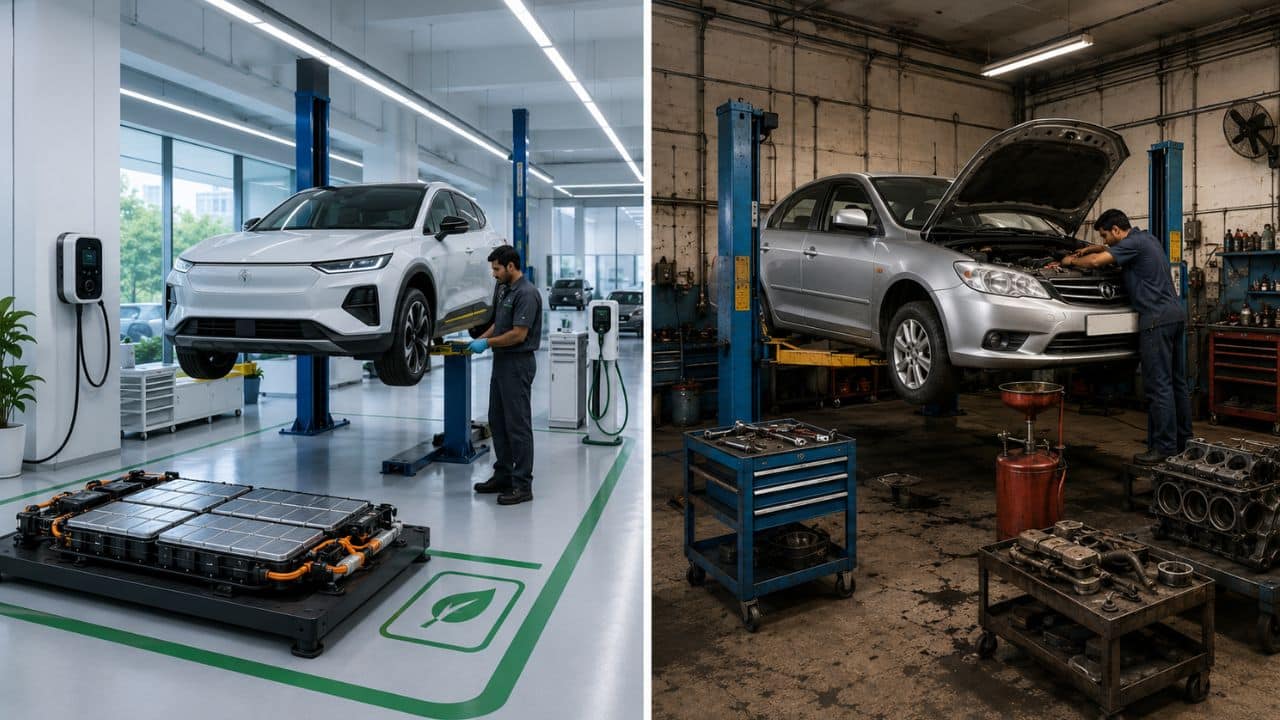

Every EV vs petrol comparison mentions lower maintenance, but few explain exactly where the savings actually come from, or where they don’t. The honest answer is that EVs save you money on some things substantially, cost roughly the same on others, and in a couple of specific cases, can even cost more. This guide breaks it down component by component so you can work out what it actually means for your own ownership pattern, rather than taking a vague percentage figure at face value.
Why the Comparison Starts With the Engine
A petrol engine has hundreds of moving parts working together under heat and pressure: pistons, valves, a timing belt or chain, spark plugs, a fuel injection system, an exhaust system with a catalytic converter, and a multi-speed transmission with its own fluid and wear parts. Every one of these is a potential service item with its own maintenance schedule, and several of them (the timing belt, the clutch on a manual, the exhaust system) are expensive to replace when they eventually wear out.
An EV has none of this. The drivetrain is a battery pack, an electric motor, an inverter, and a controller, with no combustion, no multi-speed gearbox in most cases, and dramatically fewer parts that experience mechanical wear. This structural difference is the entire reason EV maintenance costs less, not a marketing claim layered on top of a similar mechanical package.
What You Save On
Engine oil and filters: A petrol car needs periodic oil changes, along with an oil filter replacement at the same time, as a core part of every service visit. An EV has no engine oil at all, which removes one of the most frequent and predictable cost items in petrol car ownership entirely.
🚀 Join Our Tech Community!
Get the latest news, updates, and tech trends delivered straight to your phone. Never miss an update!
Spark plugs, fuel filters, and fuel system servicing: These exist specifically to support combustion and don’t exist on an EV, since there’s no fuel being burned.
Exhaust system and catalytic converter: A petrol car’s exhaust system degrades over time, particularly in humid or flood-prone conditions, and catalytic converter issues can be a genuinely expensive repair. An EV has no exhaust system to fail.
Clutch and transmission wear: A manual petrol car’s clutch wears with use and eventually needs replacement, an expensive job. Most EVs use a single-speed reduction gear rather than a multi-speed transmission, removing both the clutch and most of the transmission-related wear items from the equation.
Brake pad wear: Regenerative braking means the electric motor handles a meaningful share of everyday deceleration, so the mechanical brake pads on an EV typically last longer between replacements than on a comparable petrol car, where the friction brakes do all the work every time.
Coolant and cooling system complexity: Petrol engines need a cooling system to manage combustion heat, with its own set of hoses, a radiator, and periodic coolant changes. EVs also need cooling, for the battery and motor rather than a combustion process, but the system is generally simpler and the cooling demands are more predictable.
What Stays Roughly the Same
Tyres: Tyre wear depends mainly on weight, driving style, and road surface, not on what powers the vehicle. In fact, EVs are often somewhat heavier than an equivalent petrol car due to battery weight, and deliver full torque instantly, both of which can mean tyre wear is comparable or in some cases even slightly higher on an EV rather than lower.
Cabin filters, wiper blades, and general wear items: These have nothing to do with the powertrain and need the same periodic attention regardless of what’s under the vehicle.
Insurance: EV insurance doesn’t automatically cost less, and can sometimes cost more, since the battery pack is expensive to repair or replace and factors into the vehicle’s insured value. Don’t assume insurance follows the same “EVs are cheaper” pattern as servicing; compare actual quotes for your specific model.
What Can Cost More
Specialised service access: Anything touching the high-voltage battery or drive unit needs a manufacturer-authorised or otherwise qualified EV technician rather than a general neighbourhood mechanic. In cities with a thin authorised network, this can mean fewer options and, occasionally, higher labour costs or longer turnaround times than a petrol car would face at an ordinary local garage.
Battery replacement, in the rare case it’s needed outside warranty: This is the one genuinely large cost risk unique to EV ownership, and it’s worth being clear-eyed about rather than glossing over. Most manufacturers back the battery with a warranty that covers a substantial period and guarantees a minimum capacity retention, and battery lifespan for a well-maintained pack generally extends well beyond that warranty window in normal use. But an out-of-warranty battery replacement, should it ever be needed, is a significant expense, and it’s exactly why the battery warranty terms matter more than almost any other spec when you’re buying (see our EV buying guide for what to check specifically). For most owners within the warranty period, this risk is fully covered and shouldn’t factor into your running-cost math at all.
Working Out Your Own Numbers
Rather than quoting a single rupee figure that will be stale within months given how much petrol prices and electricity tariffs vary by state and change over time, here’s the actual formula worth running for yourself:
Petrol running cost per km = current petrol price in your city ÷ your car’s real-world km/l (not the claimed ARAI figure).
EV running cost per km = your home electricity tariff per kWh × the EV’s real-world kWh consumption per km (check owner-reported figures, not just the manufacturer’s claim).
Frequently Asked Questions
Do EVs really cost less to maintain than petrol cars in India?
Yes, structurally, because EVs lack an engine, exhaust system, and in most cases a multi-speed transmission, all common sources of routine petrol car maintenance. The exact percentage saved varies by vehicle and driving pattern, so treat any specific published figure as an estimate rather than a guarantee for your situation.
Do EVs have higher tyre wear than petrol cars?
Tyre wear depends on weight, torque delivery, and driving style rather than powertrain type specifically. EVs are often somewhat heavier and deliver instant torque, which can mean comparable or occasionally higher tyre wear than an equivalent petrol car, rather than automatically lower.
Is EV battery replacement a real cost risk?
It’s the one genuine large cost risk unique to EV ownership, but it’s typically covered by the manufacturer’s battery warranty for a substantial period with a guaranteed minimum capacity retention. Read your specific vehicle’s battery warranty terms carefully rather than assuming standard coverage.
Does EV insurance cost less than petrol car insurance?
Not automatically, and it can sometimes cost more, since the battery pack’s high replacement cost affects the vehicle’s insured value. Compare actual insurance quotes for your specific EV model rather than assuming lower premiums by default.