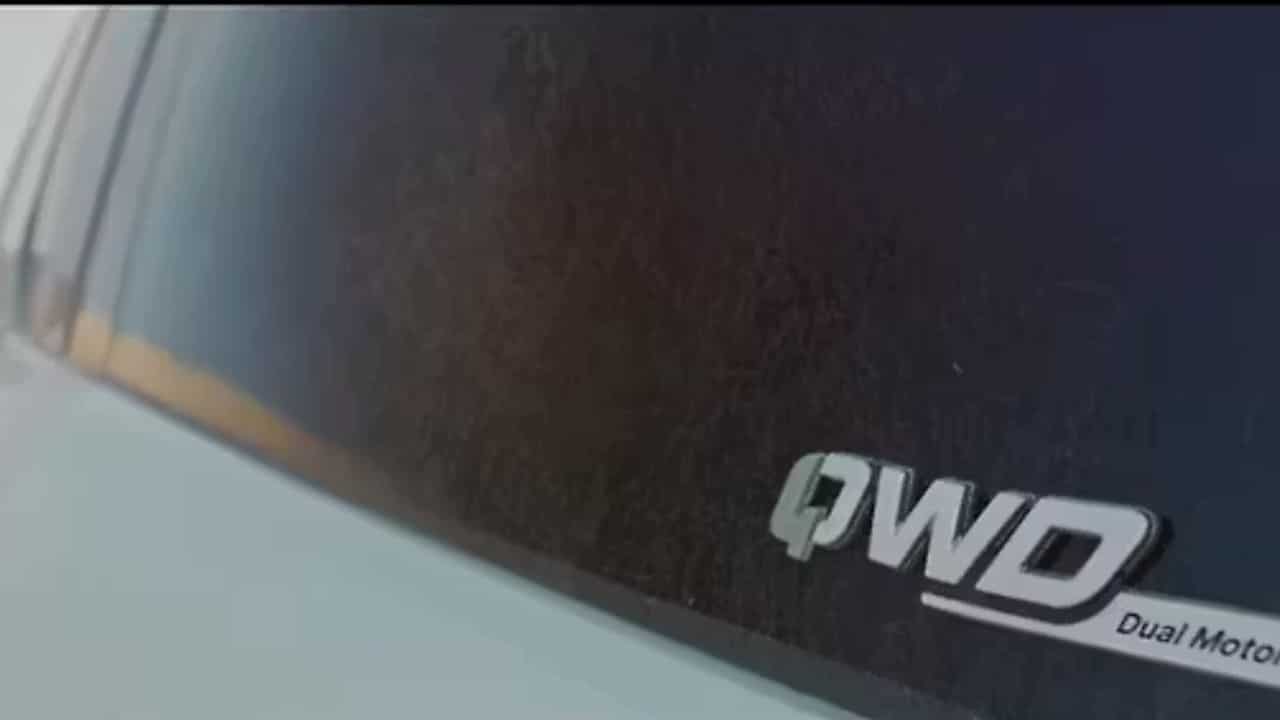

Tata calls its all-wheel-drive system on the Sierra EV QWD, badged clearly on the front doors of the variant that gets it. It’s a term you won’t find on most other Indian EV spec sheets, and it’s worth understanding exactly what it means mechanically before assuming it’s simply marketing shorthand for AWD. This guide breaks down how the Sierra EV’s rear-wheel-drive and QWD dual-motor setups actually differ, what each one costs you in real terms, and which one genuinely suits your driving.
What Does QWD Actually Mean?
QWD is Tata’s name for the Sierra EV’s dual-motor all-wheel-drive configuration. Where the standard Sierra EV uses a single electric motor driving the rear wheels, the QWD version adds a second motor at the front axle, giving the car power delivery to all four wheels simultaneously and intelligently. Rather than treating “AWD” as a single specification, it’s worth being precise here: the Sierra EV’s QWD system pairs a 209 PS rear motor with a 140 PS front motor, for a combined torque output of 504 Nm. This isn’t a token secondary motor bolted on for a marketing badge, it’s a genuinely substantial addition to the powertrain.
The QWD system is exclusively available on the Empowered A variant, paired only with the 75 kWh battery pack, at Rs 25.99 lakh (ex-showroom). There’s no way to get QWD on a lower trim or with the smaller 63 kWh battery, so if all-wheel drive is a requirement for you, this is the only entry point into the Sierra EV lineup.
RWD vs QWD: Full Comparison
| Specification | RWD (single motor) | QWD (dual motor) |
|---|---|---|
| Number of motors | 1 (rear) | 2 (front + rear) |
| Power | 209 PS (75 kWh) / 238 PS (63 kWh) | 209 PS rear + 140 PS front |
| Combined torque | 315 Nm | 504 Nm |
| 0-100 kmph | Not specified | 5.8 seconds |
| Claimed range (75 kWh, MIDC) | 665 km | 624 km |
| Terrain modes | Standard driving only | Normal, Grass/Snow, Mud-ruts/Gravel, Sand, Rock Crawl, Custom |
| Frunk space | 55 litres | 35 litres |
| Available variants | Pure, Pure S, Adventure, Empowered, Empowered A | Empowered A only |
| Battery options | 63 kWh or 75 kWh | 75 kWh only |
| Starting price | Rs 18.79 lakh | Rs 25.99 lakh |
Power and Performance Differences
The most immediately noticeable difference between the two drivetrains is outright performance. QWD’s combined 504 Nm of torque, split across two motors driving all four wheels, gets the Sierra EV from 0 to 100 kmph in a claimed 5.8 seconds, a genuinely quick time for an SUV of this size and one of the strongest figures in this price bracket. Tata’s RWD variants don’t have an officially published 0-100 kmph figure, but with 315 Nm on tap through a single motor, they’re tuned more for smooth, relaxed everyday driving than outright pace.
🚀 Join Our Tech Community!
Get the latest news, updates, and tech trends delivered straight to your phone. Never miss an update!
It’s worth revisiting a detail covered elsewhere on this site because it matters directly to this comparison: the 63 kWh RWD variant actually produces more power (238 PS) than the 75 kWh single-motor RWD variant (209 PS). So within the RWD lineup itself, power output isn’t simply tied to battery size, it’s specific to which motor Tata has paired with which pack. The QWD system is the only configuration where you get a genuine, deliberate step up in both power and torque over every RWD option in the lineup.
The Range Trade-Off Nobody Expects
Here’s the detail that surprises a lot of buyers comparing QWD against RWD on paper: choosing all-wheel drive actually reduces your claimed range. The QWD Empowered A claims 624 km on the MIDC cycle, against 665 km for the RWD 75 kWh Empowered A, a drop of 41 km despite using the identical battery pack.
This isn’t a flaw or an oversight, it’s simple physics. The additional front motor adds weight to the vehicle and introduces extra mechanical drag when both motors are engaged, both of which cost energy efficiency. It’s the same trade-off every AWD EV makes against its RWD equivalent, just made explicit here in Tata’s own claimed figures rather than something buyers have to discover after the fact through owner reports.
For buyers weighing QWD purely on the promise of “more capability, more everything,” this is the one place where QWD is objectively worse than RWD on the same battery. If maximum range is your single biggest priority, RWD with the 75 kWh pack, not QWD, is actually the stronger choice.
Off-Road Capability: Where QWD Genuinely Earns Its Price
Performance numbers and range trade-offs are one side of this comparison. The other, and arguably more important side for buyers actually considering QWD, is genuine off-road capability, and this is where the dual-motor system delivers something the RWD variants simply cannot replicate.
QWD comes with six dedicated terrain response modes: Normal, Grass/Snow, Mud-ruts/Gravel, Sand, Rock Crawl, and Custom. Each mode adjusts how power is distributed between the front and rear axles, along with traction control behaviour, to suit the specific surface. This isn’t available in any form on the RWD variants, which are tuned purely for on-road driving.
Tata’s own pre-launch demonstration, climbing the Tal Moreeb sand dune in the UAE, one of the tallest in the world, was specifically performed with the QWD variant, and while it’s undeniably a marketing exercise, it does require genuine mechanical capability to pull off rather than just a badge. For buyers who live in regions with genuinely poor monsoon roads, unpaved rural stretches, or who actively pursue off-road driving as a hobby, QWD is the only Sierra EV configuration built to handle those conditions properly.
Frunk Space: A Small But Real Practical Difference
One consequence of adding a front motor that’s easy to overlook: the QWD variant’s frunk shrinks from 55 litres on RWD models to 35 litres, since the front motor now occupies space that would otherwise be available storage. It’s a relatively minor point compared to the performance and range differences, but if you specifically value the frunk for keeping charging cables separate from your main luggage, it’s worth factoring in that QWD gives you noticeably less of that space to work with.
Price Gap: Is QWD Worth Rs 1.2 Lakh Over RWD Empowered A?
Comparing like for like on the same trim and battery, QWD costs Rs 1.2 lakh more than the RWD 75 kWh Empowered A (Rs 25.99 lakh versus Rs 24.79 lakh). Both variants carry the same feature list otherwise, so this premium is purely for the drivetrain difference: the second motor, the terrain modes, and the performance gain, against a 41 km range reduction and a smaller frunk.
Whether that’s worth it comes down entirely to how you’ll use the car. If your driving is exclusively on paved roads, even poorly maintained ones, the RWD variant’s ESC, ABS, and all-wheel disc brakes already provide strong everyday safety and control without needing a second motor. QWD’s premium only pays for itself if you’re genuinely going to use the terrain modes, or if the extra torque and quicker acceleration matter enough to you personally to accept the range trade-off.
Common Misconceptions About QWD
“QWD means better wet-weather safety on regular roads.” Not particularly, at least not meaningfully beyond what the RWD variant already offers. Electronic Stability Control and ABS, both standard across the Sierra EV lineup, do most of the practical work in keeping the car stable on wet tarmac. QWD’s real advantage shows up specifically in low-traction, off-road conditions like mud, sand and loose gravel, not routine monsoon driving on paved city roads.
“The bigger battery on QWD means better range than RWD.” This is backwards. Both the QWD and the top RWD variant use the identical 75 kWh pack, and QWD’s claimed range is actually lower, not higher, due to the added weight and drag of the second motor.
“QWD is just a marketing name for a software-limited AWD system.” Not based on the specifications published so far. The 140 PS front motor is a genuine, physical addition to the powertrain producing real, measurable torque, not a software-only traction adjustment on a single motor.
Who Should Choose RWD
Choose RWD if your driving is predominantly on paved roads, even rough or pothole-heavy ones, if maximum range matters more to you than outright acceleration, or if you want the flexibility to choose the smaller 63 kWh battery to save further on upfront cost. RWD is also the only route into the Sierra EV lineup below Rs 22.79 lakh, so budget-conscious buyers are effectively choosing RWD by default unless they specifically stretch for the Empowered A.
Who Should Choose QWD
Choose QWD if you genuinely need off-road capability, whether for regular rural or hilly terrain, monsoon-affected unpaved roads, or recreational off-roading, or if the sharper 5.8-second 0-100 kmph acceleration and 504 Nm of torque are worth the price and range trade-off to you personally. Go in accepting that QWD is a specific-use-case purchase, not simply the “better” version of the Sierra EV in every respect, since it trades range for capability rather than improving on every metric simultaneously.
Frequently Asked Questions
What does QWD mean on the Tata Sierra EV?
QWD is Tata’s name for the Sierra EV’s dual-motor all-wheel-drive system, combining a 209 PS rear motor and a 140 PS front motor for 504 Nm of combined torque.
Does the Tata Sierra EV QWD variant have less range than RWD?
Yes. The QWD Empowered A claims 624 km (MIDC) against 665 km for the RWD 75 kWh Empowered A, a difference caused by the added weight and drag of the second front motor.
Can I get QWD with the 63 kWh battery?
No. QWD is only available with the 75 kWh battery pack, exclusively on the Empowered A variant.
Is QWD worth the extra Rs 1.2 lakh over the RWD Empowered A?
It depends on your use case. QWD is worth it if you need genuine off-road capability or want the quicker 5.8-second 0-100 kmph acceleration. If maximum range and a lower price matter more, the RWD Empowered A is the stronger choice.