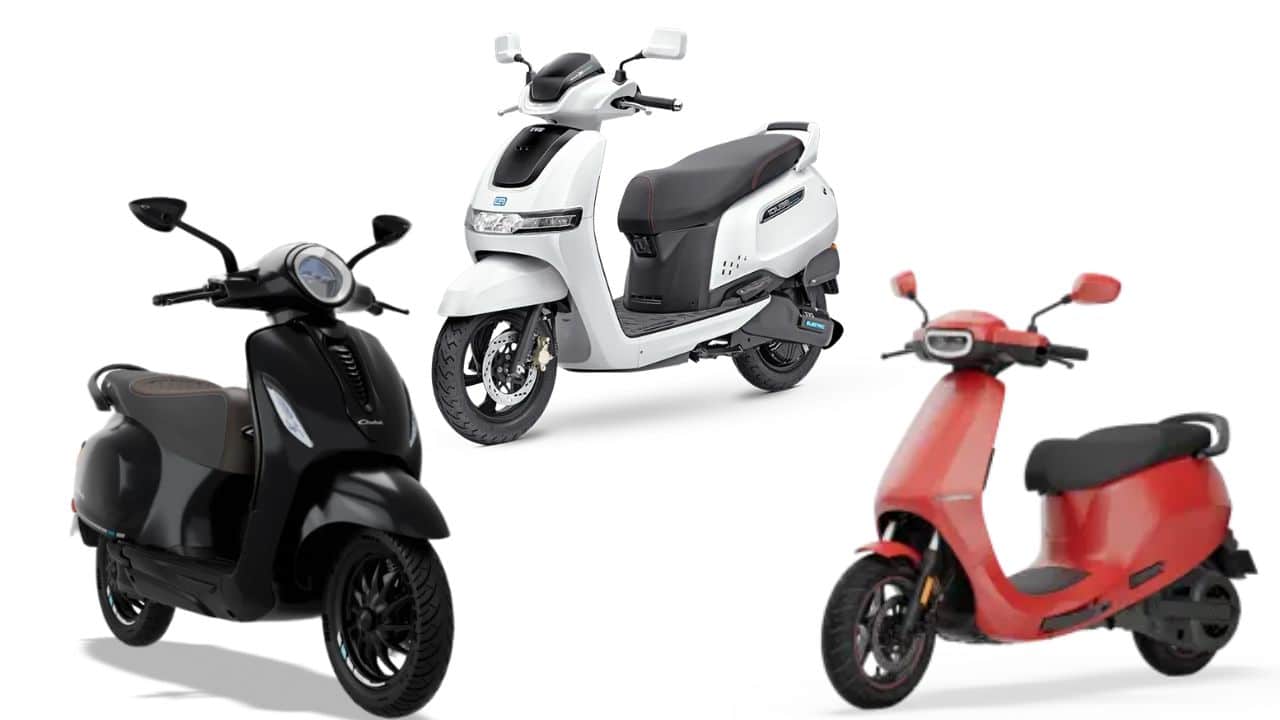

India’s EV two-wheeler market crossed 2 lakh units in a single month for the first time in July 2026, with VAHAN portal registrations totalling 2,04,266 units. TVS Motor led the segment with 55,477 units and a 27% share, Bajaj Auto followed with 45,592 units and 22%, and Ola Electric, once the category’s dominant player, registered just 14,106 units for a 6.9% share, according to VAHAN registration data and FADA Research.
EV Two-Wheeler Registrations, July 2026
| OEM | Registrations | Market Share | YoY Growth |
|---|---|---|---|
| TVS Motor | 55,477 | 27.2% | +135% |
| Bajaj Auto | 45,592 | 22.3% | +122% |
| Ather Energy | 30,323 | 14.8% | +70% |
| Hero MotoCorp (Vida) | 22,900 | 11.2% | +111% |
| Ola Electric | 14,106 | 6.9% | -23.5% |
| Others (Greaves/Ampere, River, Bgauss, Simple, Lectrix, etc.) | 35,868 | 17.6% | – |
| Total EV 2W Market | 2,04,266 | 100% | – |
TVS and Bajaj now hold nearly half the market between them
TVS and Bajaj alone accounted for 49.5% of every EV two-wheeler registered in India in July, a level of combined dominance the segment hasn’t seen before. Both brands grew registrations by well over 100% year-on-year, off a base that was already large. TVS’s 55,477 units marked its highest-ever monthly figure, beating its previous best of 51,632 units set in March, and pushed its share up from 22% a year earlier. Bajaj’s 45,592 Chetak units gave it its second-best month after March’s 47,751, with share climbing from 19% to 22% over the same twelve months.
Ather Energy held its position as the clear third-place brand, retailing 30,323 units, up 70% year-on-year, even as volumes eased slightly from June’s 31,440. Hero MotoCorp’s Vida brand posted the fastest percentage growth of the top five at 111%, closing in on Ather with 22,900 units.
Ola’s decline is now structural, not seasonal
Ola Electric’s 14,106 units represent a 23.5% year-on-year drop from the 18,450 units it retailed in July 2025, and its 6.9% share is a fraction of the roughly 26% it commanded as recently as mid-2025. This isn’t a one-month dip. Ola has now trailed every other top-five EV two-wheeler brand on year-on-year growth for several consecutive months, and its January-July 2026 cumulative registrations of around 82,000 units work out to a run rate that would leave it well short of even its already-diminished 2025 full-year total.
🚀 Join Our Tech Community!
Get the latest news, updates, and tech trends delivered straight to your phone. Never miss an update!
The company itself has acknowledged the shift. Ola recently moved away from its direct-sales-only model, a strategy it had leaned on since 2023, as sales continued to soften. That’s a meaningful reversal for a brand that once used its no-dealer, no-showroom approach as a core part of its pitch.
Why the wholesale-retail lens matters more for Ola than for its rivals
For most of this segment, wholesale (what a company ships or reports as sold) and retail (what VAHAN shows as actually registered) track each other closely enough that the distinction is a formality. Ola is the exception, and the reason is worth understanding. Through 2025, Ola’s own disclosed “sales” figures repeatedly diverged from what VAHAN showed as registered, at one point by a factor of nearly three in the same month, which drew scrutiny from the Ministry of Heavy Industries and, separately, questions reported around SEBI’s review of the company’s disclosures. Ola’s position at the time was that its figures reflected bookings and deliveries, not registrations, and that the two would not always match in a given month.
Since that scrutiny, Ola has increasingly disclosed VAHAN registration numbers directly to exchanges as its headline metric, rather than a separately branded “sales” figure, which is part of why the 14,106 figure above can be treated as both the wholesale-adjacent company disclosure and the retail registration count for July. For a reader tracking Ola specifically, that convergence is itself a data point: it removes the ambiguity that complicated reading the brand’s numbers through 2025.
TVS presents the opposite situation. The company’s own July release cited 60,934 units of two-wheeler EV sales, a figure that includes export dispatches alongside domestic volume, against VAHAN’s domestic-only registration count of 55,477. The roughly 5,450-unit gap is a normal wholesale-retail spread for a company that sells the iQube and Orbiter both in India and overseas, and shouldn’t be read as inventory stress. Bajaj and Ather do not break out EV-specific wholesale figures separately from their overall two-wheeler dispatch totals, so VAHAN registration remains the only consistent public benchmark for comparing them against TVS and Ola on a like-for-like basis.
Frequently Asked Questions
What was Ola Electric’s EV two-wheeler market share in July 2026?
Ola Electric held a 6.9% share of India’s EV two-wheeler market in July 2026, with 14,106 units registered, down 23.5% year-on-year, according to VAHAN portal data and FADA Research.
Which brand led the EV two-wheeler market in July 2026?
TVS Motor led with 55,477 units registered and a 27% market share, ahead of Bajaj Auto’s 45,592 units and 22% share, per VAHAN registration data.
Why does TVS’s own reported EV sales figure differ from its VAHAN registration count?
TVS’s company-disclosed figure of 60,934 units for July 2026 includes export dispatches of the iQube and Orbiter alongside domestic sales, while VAHAN’s 55,477 reflects only domestic registrations, which is the standard wholesale-versus-retail distinction applied to an export-active brand.
Has Ola Electric’s reported sales figure matched VAHAN registrations in 2026?
For July 2026, yes. Following regulatory scrutiny in 2025 over gaps between its announced sales and VAHAN data, Ola has increasingly disclosed VAHAN registration figures directly rather than a separate company sales number.