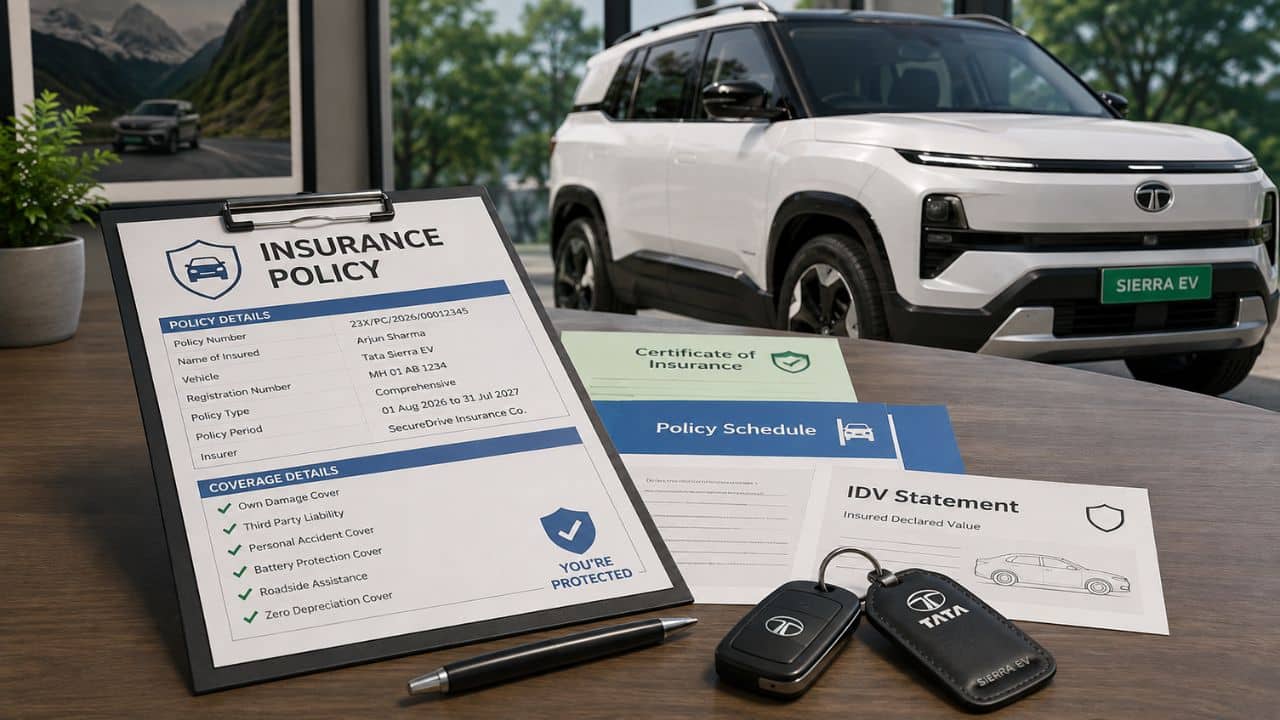

Insurance on the Sierra EV isn’t a flat number. It moves with your variant, your city, the IDV you choose, and which add-ons you pick, and the gap between a bare-minimum policy and a well-covered one can run into tens of thousands of rupees a year. Here’s what actually drives that number and what’s genuinely worth paying for.
What Determines Your Premium
Insured Declared Value (IDV): This is the car’s current market value, and it’s the figure your insurer pays out on if the Sierra EV is stolen or written off. A higher IDV means a higher premium but also a bigger payout if the worst happens. A lower IDV cuts your premium but leaves you short if you ever need to claim. For a car in this price bracket, don’t chase the cheapest premium by setting IDV artificially low. It’s a false saving that only shows up when you actually need the policy.
Third-party premium slab: Unlike petrol or diesel cars, where third-party premium is set by engine cc, EV third-party rates are set by motor power in kW, in slabs defined by IRDAI. The Sierra EV’s motors, whether the single-motor base variant or the dual-motor AWD setup, sit well above the lowest kW bracket, so expect the third-party portion of your premium to land in a higher slab than a small commuter EV would. Ask your insurer to break out the third-party and own-damage components separately so you can see exactly what you’re paying for each.
Geographical location: Metro cities carry higher premiums than smaller towns, purely because accident frequency, theft rates, and traffic density are higher. If you’re registering the Sierra EV in a metro, budget for a premium on the higher end of what your insurer quotes.
🚀 Join Our Tech Community!
Get the latest news, updates, and tech trends delivered straight to your phone. Never miss an update!
No Claim Bonus (NCB): If you’re bringing NCB over from a previous vehicle or building it up over the Sierra EV’s own claim-free years, it directly cuts your premium, up to a meaningful discount at the higher NCB tiers. This is one of the few levers genuinely in your control after the first year.
Add-ons Every add-on you include raises the premium, sometimes by a little, sometimes by a lot depending on the cover. The right approach is to add what you’d genuinely use, not everything the dealer’s insurance desk offers by default.
What a Sierra EV Premium Actually Looks Like
To put real numbers against this rather than leaving it abstract, here’s what the comprehensive first-year premium looked like on a couple of variants at the time of writing, drawn from an on-road price breakdown: the base Sierra EV Pure (63 kWh, RWD) carried an insurance premium of roughly ₹81,487, while a top AWD variant carried a premium closer to ₹1,29,264. That’s a gap of nearly ₹48,000 between the two ends of the lineup, driven mainly by the higher IDV and larger battery/motor package on the top trim.
Treat these as illustrative rather than a quote for your specific policy. Your actual premium will depend on your city, chosen insurer, IDV negotiation, NCB status, and add-on selection, and it’s worth getting quotes from two or three insurers rather than accepting the first number your dealership offers.
Add-Ons Worth Considering for an EV Specifically
Zero depreciation cover: On any car this expensive, zero depreciation is close to essential. Without it, your insurer deducts a depreciation percentage from parts during a claim, and on an EV with battery and motor components, that deduction can be significant.
Battery and motor protection cover: This is the EV-specific add-on worth paying real attention to. A standard comprehensive policy doesn’t always treat high-voltage battery and motor damage the same way it treats a conventional engine, so check explicitly whether your policy’s own-damage cover extends fully to the battery pack, or whether you need a separate rider for it. This is not the place to assume “comprehensive” covers everything by default.
Roadside assistance: Worth having on any EV, since a flat battery or a charging-related breakdown away from home is a different kind of stranded than a petrol car running dry, and most insurers bundle 24×7 roadside assistance into this add-on at a modest additional cost.
Consumables cover: Less critical on an EV than on an ICE vehicle, since there’s no engine oil or coolant to worry about, but still useful for items like brake fluid and washer fluid that do get consumed during a repair.
Engine protection add-on: Skip this one specifically for the Sierra EV. It’s built around ICE engine damage from water ingress or oil leaks, neither of which applies to an EV’s motor and battery setup. If your insurer tries to bundle it in by default, ask for it to be removed and check whether a proper battery protection rider exists instead.
Practical Ways to Bring the Premium Down
Compare quotes from at least two or three insurers before renewing, since premiums for the same IDV and coverage can vary noticeably between insurers, and Sierra EV owners with a claim-free first year should make sure that NCB is correctly reflected the moment renewal comes up. Installing an approved anti-theft device can also shave a small percentage off the premium with most insurers, and it’s a cheap addition relative to the annual saving. Avoid the temptation to drop own-damage cover entirely to save money in year one. On a car in this price range, the gap between a comprehensive policy and third-party-only cover is small relative to what you’d be exposed to in an accident or theft claim.
Frequently Asked Questions
Why is the Sierra EV’s third-party insurance different from a petrol car’s?
EV third-party premiums are set by motor power in kilowatts rather than engine capacity in cc. Since the Sierra EV’s motors sit well above the lowest kW bracket, its third-party premium falls in a higher slab than a small petrol hatchback would.
Does standard comprehensive insurance cover the Sierra EV’s battery?
Not always automatically. Check specifically whether your policy’s own-damage cover extends to the high-voltage battery pack, or whether a separate battery protection rider is needed, since this varies by insurer.
Should I buy engine protection cover for the Sierra EV?
No. Engine protection add-ons are built for ICE engine damage from water ingress or oil leaks, which don’t apply to an EV. Ask instead about a dedicated battery and motor protection rider.
How much does Sierra EV insurance actually cost?
As an example, a base Sierra EV Pure variant carried a first-year comprehensive premium of around ₹81,487, while a top AWD variant carried roughly ₹1,29,264, based on one on-road price breakdown. Your actual premium will vary by city, insurer, IDV, and add-ons chosen.