
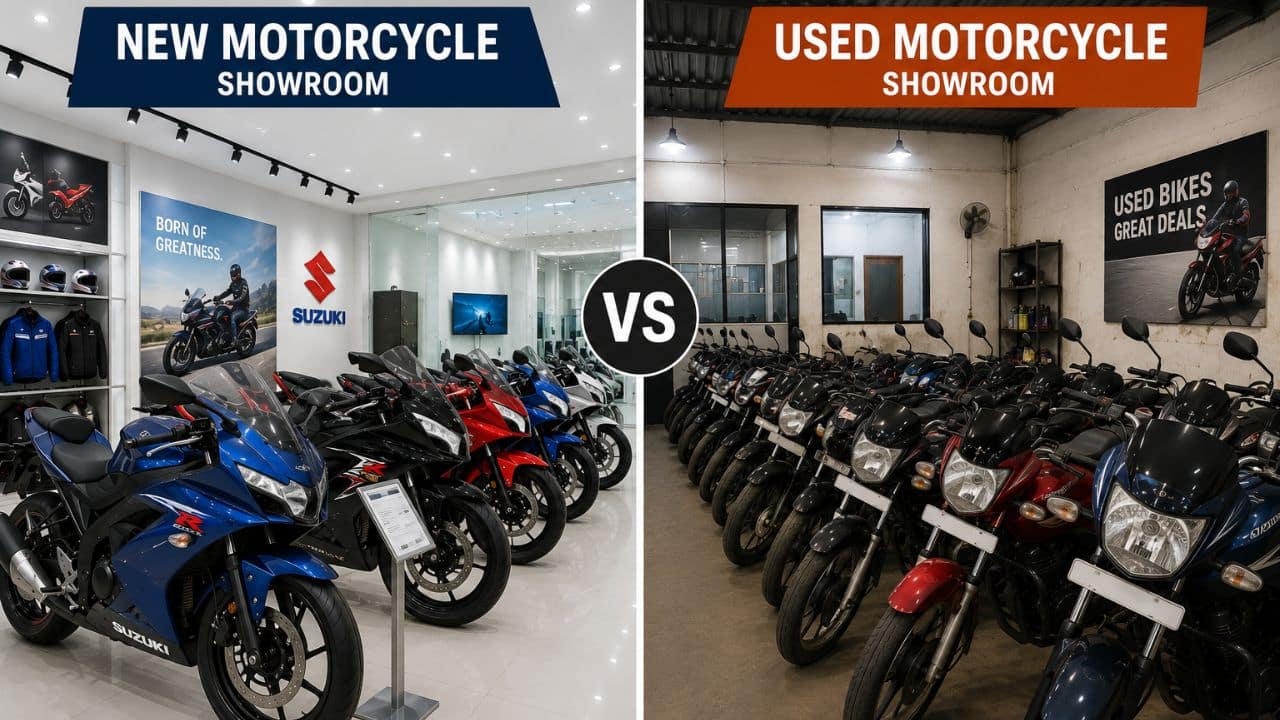

There’s no universally correct answer to this question, and anyone who tells you otherwise is probably trying to sell you something. A new motorcycle and a well-chosen used one solve genuinely different problems, and the right choice depends far more on your specific situation, budget flexibility, risk tolerance, and what you actually want from the ownership experience, than on any blanket rule about which is objectively “smarter.”
The Core Trade-Off
Buying new gets you a full warranty, zero unknown history, the latest features and safety tech for that model, and the ability to choose your exact color and variant. It also means absorbing the steepest depreciation hit in the vehicle’s life, since a new motorcycle loses a meaningful chunk of its value the moment it’s registered and ridden out of the showroom.
Buying used means someone else already absorbed that steep initial depreciation, so your money buys more bike for the price, or the same bike for meaningfully less. It also means inheriting unknown wear, a shorter or absent remaining warranty, and a genuine research burden to confirm the specific bike you’re looking at is actually in the condition it’s presented as.
Why New Motorcycles Depreciate So Fast Early On
A motorcycle’s steepest value drop happens in the first year, often losing a significant percentage of its original price within the first twelve months, even with careful ownership and low mileage. This isn’t unique to motorcycles or to India, it reflects how any new vehicle transitions from “brand new, zero owners” to “used, one owner” the moment it’s registered, and that status change alone accounts for a real chunk of the value lost, independent of actual wear or condition.
🚀 Join Our Tech Community!
Get the latest news, updates, and tech trends delivered straight to your phone. Never miss an update!
This is genuinely useful information for a used-motorcycle buyer, since it means a one or two-year-old bike in excellent condition often represents meaningfully better value than the identical model bought new, assuming the used unit’s actual condition holds up to scrutiny.
The Case for Buying New
Full manufacturer warranty from day one removes a significant category of financial risk, particularly valuable for a first-time buyer who doesn’t yet have the experience to spot early warning signs of a developing mechanical issue.
Zero unknown history means you know exactly how the bike has been ridden and maintained, since you’re the one doing both from the start. This matters more to some buyers than others, but for someone who’s been burned by an unreliable used purchase before, or who simply values that certainty, it’s a genuine, legitimate reason to pay the premium.
Access to the latest features and safety tech for that specific model, ABS variants, updated engine tuning, current styling, without needing to compromise on an older generation’s specification.
Financing is generally more straightforward for new vehicles, with more lenders offering competitive rates and terms compared to used-vehicle loans, which sometimes carry higher interest rates or more restrictive eligibility criteria.
The Case for Buying Used
Meaningfully lower purchase price for the same or a comparable model, sometimes allowing a buyer to afford a higher trim or a larger-displacement bike than their budget would stretch to for a new equivalent.
Someone else absorbed the steepest depreciation, meaning a well-chosen used bike often holds its remaining value more steadily going forward than a brand-new one would over the same period.
A wider selection across price points, since the used market includes older, discontinued, or otherwise unavailable-new models that might genuinely suit a buyer’s needs better than anything currently in production at their budget.
Lower insurance premiums in many cases, since Insured Declared Value, and therefore premium cost, is generally lower for an older bike than an equivalent new one.
The Real Risks of Buying Used, and How to Manage Them
Unknown maintenance history is the single biggest risk. A used bike with no service records or an inconsistent, gap-filled history is a genuine unknown, you’re trusting the seller’s word for how it’s actually been treated. Always ask for complete service records, and treat their absence as a legitimate reason to either negotiate the price down significantly or walk away entirely.
Odometer tampering does happen, and a suspiciously low reading for a bike’s age, without documentation to support it, should raise questions rather than automatically seem like a good deal. Cross-check the claimed mileage against wear indicators, tyre condition, seat wear, chain stretch, that are harder to fake convincingly.
Remaining warranty coverage varies enormously. Some used bikes still carry meaningful remaining manufacturer warranty if bought within the original coverage period and properly transferred, others have none at all. Confirm this explicitly with the seller and, where possible, verify directly with the manufacturer or an authorized service center rather than taking the seller’s word alone.
A pre-purchase inspection is worth the cost. For anything beyond a very low-value bike, having a trusted, independent mechanic inspect the specific unit before you commit is one of the highest-value steps in the entire used-buying process, and it’s a genuinely small cost relative to the risk it manages.
When New Genuinely Makes More Sense
A first-time buyer with no prior experience assessing a used vehicle’s condition is generally better served starting with new, the warranty protection alone offsets a meaningful amount of risk during a phase where you don’t yet have the knowledge to spot problems yourself. A buyer specifically wanting the latest safety features, current-generation ABS, updated engine tech, on a particular model also has a legitimate reason to buy new, since these updates aren’t available on older used units of the same nameplate. And a buyer for whom financing terms and predictable, warranty-backed ownership matter more than squeezing out maximum value per rupee has a reasonable case for new as well.
When Used Genuinely Makes More Sense
A buyer with the knowledge, or access to someone with the knowledge, to properly assess a used bike’s real condition can often get significantly more motorcycle for their money by going used, particularly one or two years old rather than significantly older. A budget-constrained buyer who wants a higher-displacement or better-equipped bike than a new purchase at the same price would allow has a legitimate case for used specifically because someone else already absorbed the first year’s depreciation. And a buyer specifically looking for a discontinued or older-generation model, one they’ve researched and specifically want rather than settling for whatever’s currently in production, will only find that option in the used market.
A Practical Middle Ground: Certified Pre-Owned Programs
Several manufacturers and larger dealership networks in India now offer certified pre-owned motorcycle programs, which typically include a manufacturer or dealer-backed inspection process and sometimes a limited warranty on the used unit. This can meaningfully reduce the uncertainty risk associated with a private used purchase, at a price premium over an equivalent bike bought privately from an individual seller. For a buyer who wants some of used buying’s value advantage without absorbing the full uncertainty of a private sale, this is worth researching as a genuine middle option where it’s available for the specific model you’re considering.
Comparison at a Glance
| Factor | Buying New | Buying Used |
|---|---|---|
| Purchase price | Highest | Meaningfully lower for comparable spec |
| Warranty | Full manufacturer coverage | Varies, sometimes none remaining |
| Depreciation absorbed | You absorb the steepest drop | Previous owner already absorbed it |
| Condition certainty | Guaranteed, zero prior wear | Requires inspection and verification |
| Feature/tech currency | Latest available for the model | Depends on the specific model year |
| Financing | Generally more accessible | Sometimes higher rates, fewer lenders |
Frequently Asked Questions
Is it always financially smarter to buy used?
Not always, it depends on the specific bike’s condition, remaining warranty, and how much the price gap between new and used actually is for that model. A used bike with an unclear history and no remaining warranty can end up costing more in unexpected repairs than the upfront savings justified, so the “smarter” choice depends on the specific unit, not a blanket rule.
How old should a used motorcycle be to get the best value?
Generally, a bike one to three years old often represents strong value, since it’s already absorbed the steepest first-year depreciation while still being relatively current in terms of features and remaining mechanical life. This varies by model and how well the specific unit has been maintained, so treat it as a general pattern rather than a fixed rule.
Should a first-time rider ever consider buying used?
It can work, particularly if a knowledgeable friend or a paid, independent inspection helps assess the specific bike’s condition. A first-time rider without that support is generally safer starting with a new bike, where warranty protection reduces the financial risk of not yet being able to spot developing mechanical issues themselves.
Do certified pre-owned motorcycle programs actually reduce risk?
Generally yes, since they typically include a structured inspection process and sometimes a limited warranty that a private used purchase won’t offer. They usually cost more than an equivalent private-sale used bike, so weigh that premium against how much you value the added certainty for your specific situation.