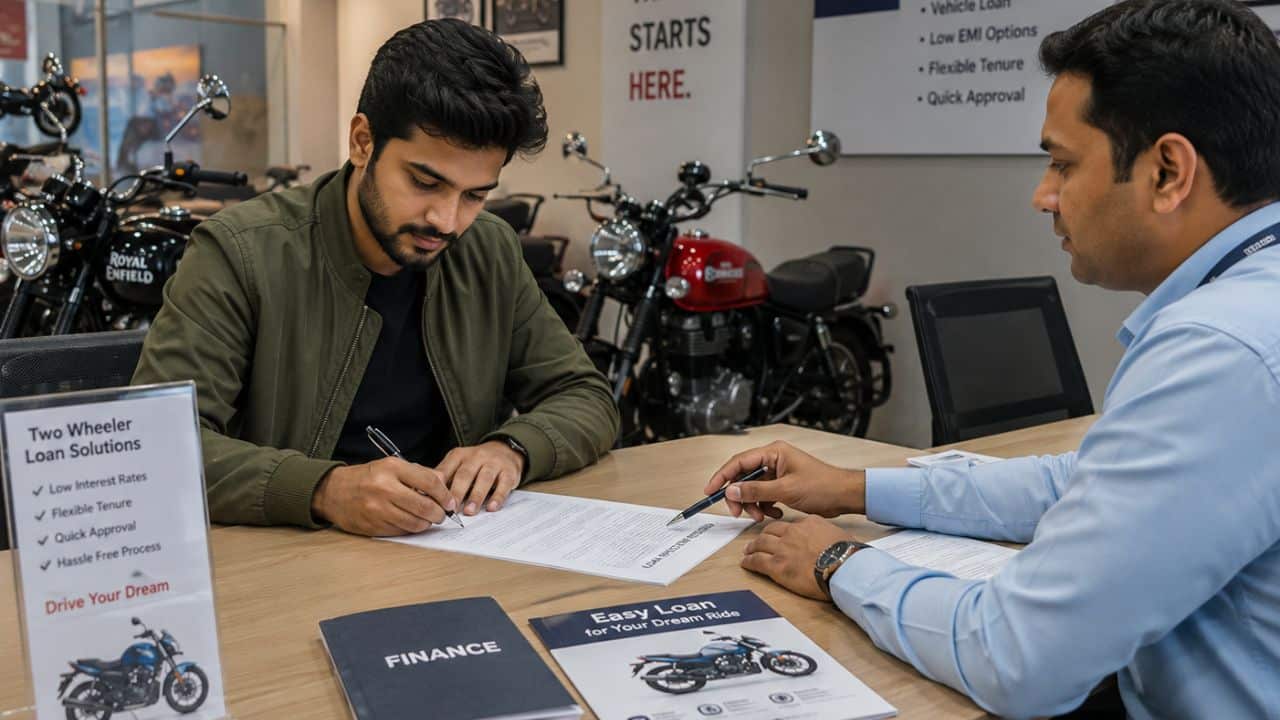

Most motorcycles in India aren’t bought outright in cash, they’re financed. Walk into almost any dealership and the finance desk is doing as much business as the sales floor. But EMI math gets thrown around loosely, just ₹3,000 a month sounds simple until you realize that number depends on at least four moving parts, and getting even one of them wrong changes what you actually end up paying over the life of the loan.
This guide breaks down how motorcycle loans actually work in India, without pushing you toward any specific lender or rate. Actual interest rates, processing fees, and eligibility criteria vary by lender and change over time, so treat the ranges here as a starting reference and confirm current terms directly with your bank, NBFC, or dealership finance partner before signing anything.
The Four Things That Determine Your EMI
Loan amount. This is the vehicle’s on-road price minus whatever down payment you make. A bigger down payment directly reduces your loan amount, and therefore your EMI, which is the single most controllable lever a buyer has.
Interest rate. Lenders quote this as an annual percentage, and it directly affects how much of each EMI payment goes toward interest versus actually paying down the principal. Two-wheeler loan rates in India commonly fall in a broad range depending on the lender, your credit profile, and prevailing market conditions, so the exact figure quoted to you should always be confirmed in writing before you commit, not assumed from an online estimate.
🚀 Join Our Tech Community!
Get the latest news, updates, and tech trends delivered straight to your phone. Never miss an update!
Loan tenure. This is how long you take to repay the loan, typically ranging from 12 to 48 months for two-wheelers, though some lenders extend further. Longer tenure lowers your monthly EMI but increases the total interest you pay over the life of the loan. Shorter tenure does the opposite, higher EMI, but you own the vehicle outright faster and pay less interest overall.
Down payment. Most lenders require a minimum down payment, commonly somewhere between 10 and 20 percent of the on-road price, though this varies by lender and by your credit profile. Paying more than the minimum upfront reduces both your loan amount and your total interest cost.
How EMI Is Actually Calculated
EMI stands for Equated Monthly Installment, a fixed monthly payment that combines both principal repayment and interest, calculated so the loan is fully paid off by the end of the agreed tenure. Lenders use a standard formula based on the loan amount, the monthly interest rate, and the number of months in the tenure. You don’t need to memorize the formula, virtually every bank, NBFC, and dealership website offers a free EMI calculator where you plug in these three numbers and get an instant estimate.
What’s worth understanding conceptually is that early EMI payments in any loan skew more heavily toward interest, and later payments skew more toward principal. This is standard amortization behavior, not something specific to two-wheeler loans, but it matters if you’re considering paying off the loan early, since the interest savings from early closure are larger the earlier in the tenure you do it.
What Affects the Interest Rate You’re Offered
Lenders don’t quote the same rate to everyone. A few factors commonly influence what rate you’re offered:
Your credit score is the single biggest factor for most lenders, a stronger score typically unlocks a noticeably better rate than a weak or thin credit history. Your existing relationship with the lender matters too, an existing bank customer with a salary account or prior loan history often gets preferential rates over a completely new customer. The specific vehicle and its price bracket can also influence the rate, and some manufacturers run promotional low-interest or zero-interest financing schemes through partnered lenders during specific sales periods, which is worth checking for before assuming the standard rate applies.
Processing Fees and Other Charges to Watch For
Beyond the headline interest rate, most motorcycle loans carry additional charges that affect the real cost of borrowing. A processing fee, usually a small percentage of the loan amount, is charged upfront by most lenders. Some loans also carry a prepayment or foreclosure charge if you pay off the loan before the end of the tenure, which is worth asking about specifically if you think you might want to close the loan early. Late payment penalties apply if an EMI is missed or delayed, and these can be steep enough to meaningfully affect your credit score if it happens repeatedly.
Ask your lender for the complete fee schedule in writing before signing, not just the headline interest rate. The advertised rate is rarely the full picture of what a loan actually costs.
Down Payment: Why More Isn’t Always Automatically Better
A larger down payment reduces your loan amount and your total interest paid, which sounds like an unambiguous win. In practice, it depends on your broader financial situation. If putting more money down means depleting an emergency fund or taking on other high-interest debt elsewhere to compensate, the math can work against you even though the loan itself looks cheaper on paper. A reasonable approach is to put down what your lender requires as a minimum, plus a bit more if you have genuinely spare funds, without stretching your immediate finances to hit a bigger number.
Fixed vs Reducing Balance Interest: Why the Label Matters
Some lenders quote a flat interest rate, calculated on the full original loan amount for the entire tenure. Others quote a reducing balance rate, calculated only on the outstanding principal, which shrinks with each EMI payment. A flat rate that looks lower on paper can end up costing more in total interest than a reducing balance rate that looks higher, because the two are calculated on fundamentally different bases. Always ask a lender explicitly which method they use, and where possible, compare the total interest payable in rupees, not just the quoted percentage, across different loan offers.
This article provides general information about how motorcycle financing works and isn’t financial advice. Loan terms, eligibility, and rates vary by lender and change over time, so confirm current details directly with your bank, NBFC, or dealership finance partner before making a borrowing decision.
Frequently Asked Questions
What credit score do I need for a motorcycle loan in India?
Requirements vary by lender, but a stronger credit score generally unlocks better interest rates and faster approval. Buyers with a limited or weak credit history can often still get approved, sometimes with a higher down payment requirement or a co-applicant, but should expect a less favorable rate than someone with an established, strong credit history.
Is it better to choose a longer tenure for a lower EMI?
A longer tenure lowers your monthly outgo but increases the total interest paid over the life of the loan. If your monthly budget is tight, a longer tenure makes the purchase more manageable month to month. If you can comfortably afford a higher EMI, a shorter tenure saves you money overall.
Can I prepay or foreclose a motorcycle loan early?
Most lenders allow early prepayment or foreclosure, but many charge a fee for doing so, commonly a percentage of the outstanding principal. Check this specific term before signing, since it directly affects whether early repayment actually saves you money once the fee is factored in.
Do dealerships offer better loan rates than banks?
Not necessarily. Dealership finance desks are often working with the same banks and NBFCs a buyer could approach directly, and sometimes carry a manufacturer-subsidized promotional rate that genuinely beats a standalone bank loan. It’s worth comparing a dealership’s offer against at least one or two independent lenders before deciding, rather than assuming either option is automatically cheaper.