
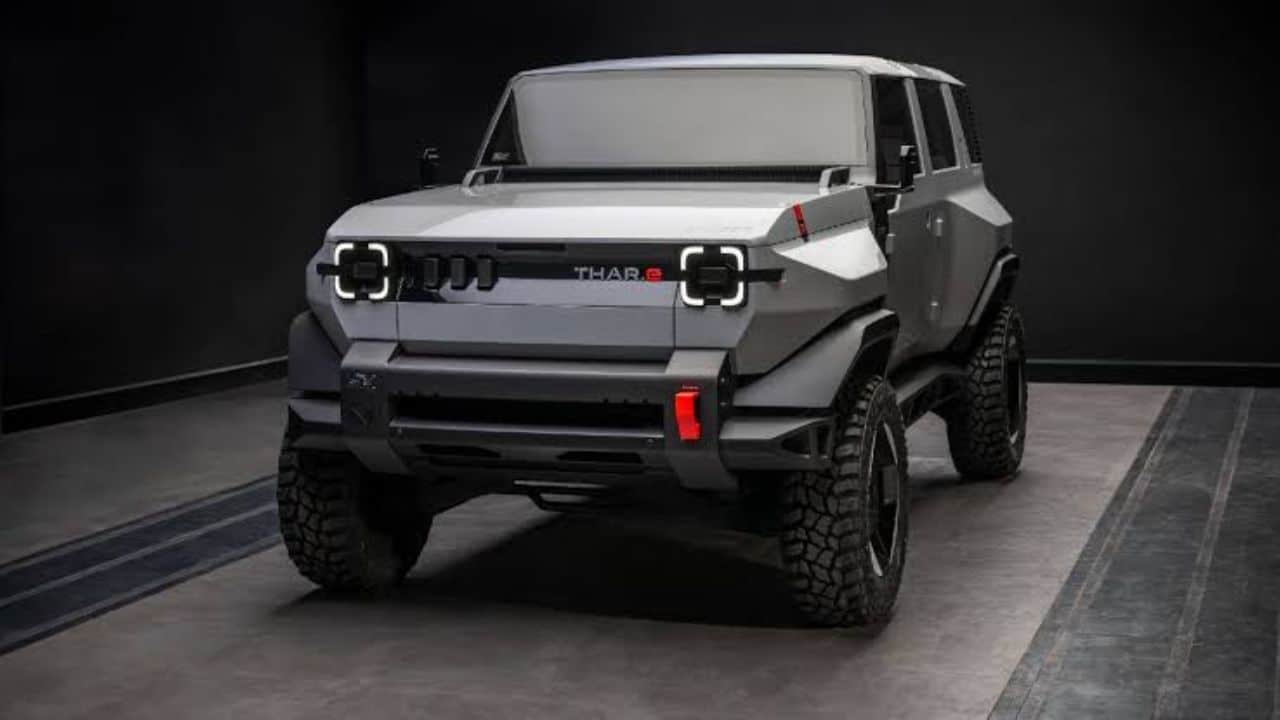

Mahindra hasn’t confirmed a launch date for the Thar.e yet. But August 15 keeps showing up across industry reports, and there’s a reason people believe it. That’s the same date Mahindra used last year to unveil the Vision.T concept, the car widely read as a preview of the production Thar.e, at its Freedom_NU event in Mumbai. A year on, with testing well advanced and the concept already public, expectation has built around Mahindra using the date again for the real thing.
What is the Thar.e, exactly?
It’s the electric version of India’s most recognisable off-roader, built from the ground up rather than being a diesel Thar with a battery bolted in. Reports say it sits on a modified version of Mahindra’s INGLO platform, the same electric architecture underneath the BE 6 and XEV 9e. That matters for one practical reason: a purpose-built EV platform lets engineers place the battery low and split weight evenly across both axles, which is exactly what off-road stability needs.
The Vision.T concept shown last August previewed a boxier, more squared-off look than the current Thar Roxx, with pronounced wheel arches, bonnet latches, and design cues clearly meant to look tougher rather than softer. Whether the production Thar.e keeps that concept styling intact, or gets toned down for a showroom, is one of the bigger open questions.
What’s reported on range and battery
Estimates vary a fair bit depending on the source, which is normal this close to launch and this far from an official spec sheet. Some reports point to battery options between 59 kWh and 79 kWh, similar to what Mahindra offers on the BE 6. Others cite a claimed real-world range in the 400 to 500 km band, though that number will move once actual testing conditions, tyres, and terrain get factored in. Off-road use, as with any EV, will pull that number down further.
🚀 Join Our Tech Community!
Get the latest news, updates, and tech trends delivered straight to your phone. Never miss an update!
Treat these as directional, not confirmed. Mahindra hasn’t published a battery spec, a certified range figure, or a charging time for the Thar.e.
Will it get all-wheel drive?
This is one of the more consistently reported details. Multiple publications expect a dual-motor all-wheel-drive layout, which would be a meaningful upgrade over the diesel Thar’s part-time 4WD setup. A dual-motor EV can send torque to each axle independently and adjust it far faster than a mechanical transfer case can, which is a genuine advantage off-road, not just a spec-sheet talking point. Ground clearance figures as high as 300 mm have been floated by some outlets, though this remains unconfirmed.
Five-door, and a wider footprint
The current Thar lineup splits between the compact three-door and the longer Thar Roxx. Reports suggest the Thar.e will land as a five-door model with a wheelbase somewhere between 2,775 mm and 2,975 mm, compared to the Roxx’s 2,850 mm. If that holds, it puts the electric Thar closer to a proper five-seat SUV than the boot-space-light three-door has ever been, which is a real shift in who the car is aimed at.
What will it cost?
Every report circling right now lands somewhere in the ₹20 lakh to ₹25 lakh ex-showroom range, with the entry trim expected closer to the lower end. That would price the Thar.e well above the diesel Thar Roxx and put it in direct range of the Maruti Suzuki eVitara, Tata Sierra EV, and Mahindra’s own BE 6. None of this is official. Mahindra typically holds pricing until the actual reveal, and this segment has seen enough revisions between “expected” and “ex-showroom” that the final number could move in either direction.
How it stacks up against the rivals it’s expected to face
If the reported specs hold, the Thar.e enters a segment that’s getting crowded fast. The eVitara and Sierra EV are both aiming at buyers who want an electric SUV without necessarily wanting a rock-crawler. The Thar.e’s pitch, going by everything reported so far, is different: keep the off-road identity the nameplate is known for, then add instant EV torque on top of it rather than trade one for the other. Against the BE 6, which shares a platform family, the Thar.e’s differentiator would be genuine off-road hardware rather than road-focused tuning. Whether that translates into a meaningfully different driving experience, or just a rugged design language on similar mechanicals, is something only a proper test can answer.
Mahindra hasn’t confirmed
Worth being direct about this: as of now, Mahindra has not officially confirmed the launch date, the battery specification, the range figure, pricing, or the final production name. Everything above comes from industry reporting and inference from the Vision.T concept, not from a Mahindra press release or investor disclosure. Anyone budgeting around these numbers should treat them as a working estimate, not a quote.
Frequently Asked Questions
When is the Mahindra Thar.e expected to launch?
Multiple industry reports point to August 15, 2026, though Mahindra has not officially confirmed a launch date.
What platform is the Thar.e built on?
It’s reported to use a modified version of Mahindra’s INGLO electric platform, the same architecture family behind the BE 6 and XEV 9e.
What is the expected price of the Mahindra Thar.e?
Reports place it in the ₹20 lakh to ₹25 lakh ex-showroom range, though official pricing hasn’t been announced.
Will the Thar.e have all-wheel drive?
Reports consistently point to a dual-motor all-wheel-drive setup, an upgrade over the diesel Thar’s mechanical 4WD system, though this remains unconfirmed until launch.