
Displacement, the cc number on every motorcycle’s spec sheet, gets treated as a proxy for how good a bike is, bigger number, better bike. That’s a genuinely unhelpful way to shop. Displacement affects performance, sure, but it also affects fuel efficiency, weight, insurance cost, and how tiring the bike is to ride in dense traffic. The right displacement is the one that matches your actual riding pattern, not the biggest figure your budget can technically reach.
What Displacement Actually Measures
Displacement is the total volume swept by all the pistons inside an engine during one complete cycle, measured in cubic centimeters (cc). In broad terms, a larger displacement engine can produce more power and torque, since it can draw in and burn more air-fuel mixture per cycle. But displacement alone doesn’t tell the whole story, engine tuning, number of cylinders, and whether it’s air-cooled or liquid-cooled all shape how that displacement actually translates into real-world performance and efficiency.
Why Bigger Isn’t Automatically Better
A larger engine generally means more weight, both from the engine itself and the reinforced frame and components needed to handle its output. More weight makes a bike harder to filter through traffic, harder to manage at a dead stop, and more tiring to ride on a short daily commute where you’re constantly starting, stopping, and maneuvering at low speed. Fuel efficiency also drops as displacement climbs, a 100cc commuter routinely returns 70 kmpl or more, while a 350cc engine typically returns less than half that. Insurance premiums and maintenance costs scale up with displacement too, in most cases, since bigger engines generally carry higher declared values and sometimes more complex servicing requirements.
None of this means bigger engines are a bad choice. It means the extra performance needs to actually get used regularly to justify the trade-offs that come with it.
🚀 Join Our Tech Community!
Get the latest news, updates, and tech trends delivered straight to your phone. Never miss an update!
100–125cc: Built for the Daily Grind
This range covers India’s largest-volume segment by far, and for good reason. Engines here are tuned almost entirely around fuel efficiency and low running cost rather than outright power, commonly delivering 65 to 83 kmpl depending on the specific model and riding conditions. Weight stays low, which makes these bikes easy to handle in bumper-to-bumper traffic and comfortable for riders still building confidence.
This is the right displacement range if your riding is mostly short-to-moderate city commuting, under roughly 25 to 30 km each way, with occasional highway stretches at most. Sustained speeds above 80 to 90 km/h will feel strained on most bikes in this range, so if regular highway travel is part of your plan, look further up this list.
125–160cc: The Everyday Step-Up
Moving into this range brings noticeably livelier acceleration and more confident overtaking without a dramatic hit to fuel efficiency, most bikes here still return somewhere in the mid-50s to mid-60s kmpl. Front disc brakes and, on many models, dual-channel ABS become standard rather than optional at this range, which matters directly for stopping confidence in wet or slippery conditions.
Riders who want a bit more performance headroom than a pure 100cc commuter offers, without stepping into a genuinely different weight and running-cost category, land well in this bracket. It also suits riders who occasionally carry a pillion or need a bit more mid-range pull for merging into faster traffic.
160–250cc: Where Real Performance Character Begins
This is the range where a motorcycle starts to feel genuinely engaging rather than purely functional. Cornering response sharpens, acceleration becomes noticeably quicker, and several bikes in this bracket introduce features like ride-by-wire throttles or quick-shifters on higher trims. Fuel efficiency drops accordingly, often into the mid-40s to low-50s kmpl range, and insurance and maintenance costs step up alongside the extra performance.
Choose this range if you genuinely enjoy the mechanics of riding, quick direction changes, confident braking, engaging throttle response, and not just as a means to get somewhere. It also suits riders whose commute includes real highway stretches where sustained higher speeds matter.
250–400cc: Touring Capability and Genuine Highway Composure
Here displacement starts buying you sustained high-speed stability that smaller engines simply can’t match without feeling stressed. Bikes in this range hold 100-plus km/h comfortably for extended stretches, which matters enormously for genuine long-distance touring or highway-heavy commuting. Fuel efficiency continues dropping, and weight climbs further, both trade-offs worth accepting only if you’ll actually use the highway capability regularly.
This range also covers Royal Enfield’s retro-classic lineup, where displacement serves character and torque feel as much as outright performance, a genuinely different value proposition than the performance-focused bikes in the same cc bracket.
400cc and Above: Serious Touring, Adventure, and Performance Riding
Above 400cc, you’re typically looking at dedicated adventure motorcycles, larger touring bikes, or genuine performance machines built for riders who’ve outgrown a smaller bike’s ceiling. Long-travel suspension, advanced electronics like multiple ride modes and traction control, and genuinely serious highway and cross-country capability define this range. Running costs, insurance, and maintenance complexity all scale up meaningfully here, and this segment makes the least sense as a primary bike for someone whose daily riding is mostly short city trips.
A Quick Reference by Use Case
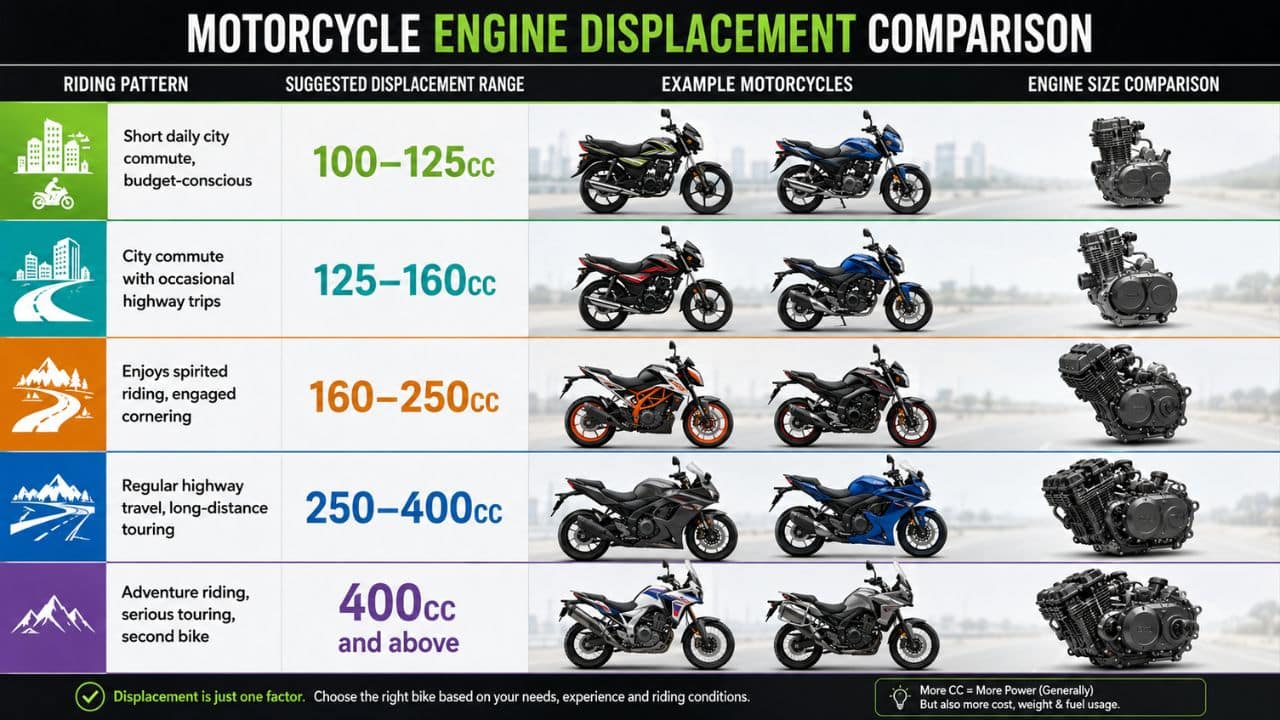
| Riding Pattern | Suggested Displacement Range |
|---|---|
| Short daily city commute, budget-conscious | 100–125cc |
| City commute with occasional highway trips | 125–160cc |
| Enjoys spirited riding, engaged cornering | 160–250cc |
| Regular highway travel, long-distance touring | 250–400cc |
| Adventure riding, serious touring, second bike | 400cc and above |
Factors Beyond Displacement That Actually Matter Just as Much
Engine tuning matters as much as raw cc. Two bikes with the same displacement can feel completely different depending on whether the engine is tuned for low-end torque or high-revving top-end power, which is why test riding matters more than comparing spec sheets alone.
Weight distribution and seat height affect low-speed control independently of displacement, a heavier bike at any cc level is harder to manage at a stop or during a U-turn than a lighter one.
Your actual riding frequency should guide the decision more than aspirational future use. Buying a 250cc bike because you might eventually take up touring, when your riding today is entirely short city trips, means paying the fuel and insurance penalty for capability you’re not yet using.
Match displacement to how you ride today, not to how you imagine riding someday. A short daily commute is served perfectly well by 100 to 125cc, and paying more for capability you won’t regularly use only adds cost without adding value. Step up in displacement only when your actual riding pattern, regular highway travel, genuine touring, a real appetite for performance riding, demands it. The right cc number is the one that matches your real weekly riding, not the one that looks most impressive on a showroom spec sheet.
Frequently Asked Questions
Is a bigger engine always more powerful than a smaller one?
Generally yes, larger displacement typically allows for more power output, but tuning matters too. A well-tuned smaller engine can outperform a poorly tuned larger one in specific situations, particularly in low-end torque delivery, so displacement alone isn’t a complete measure of real-world performance.
Does higher displacement always mean worse mileage?
In most cases, yes, larger engines burn more fuel to produce more power. There are exceptions where efficient engineering narrows the gap somewhat, but as a general rule, expect mileage to drop as displacement climbs within any given category of bike.
Should a new rider start with a bigger displacement bike to “avoid upgrading later”?
Generally no. A bike with more power and weight than a beginner can comfortably control increases the risk of losing control during the learning phase, when clutch feel, braking modulation, and low-speed balance are still developing. Starting appropriately sized and upgrading once genuine skill is in place is the safer, more common path.