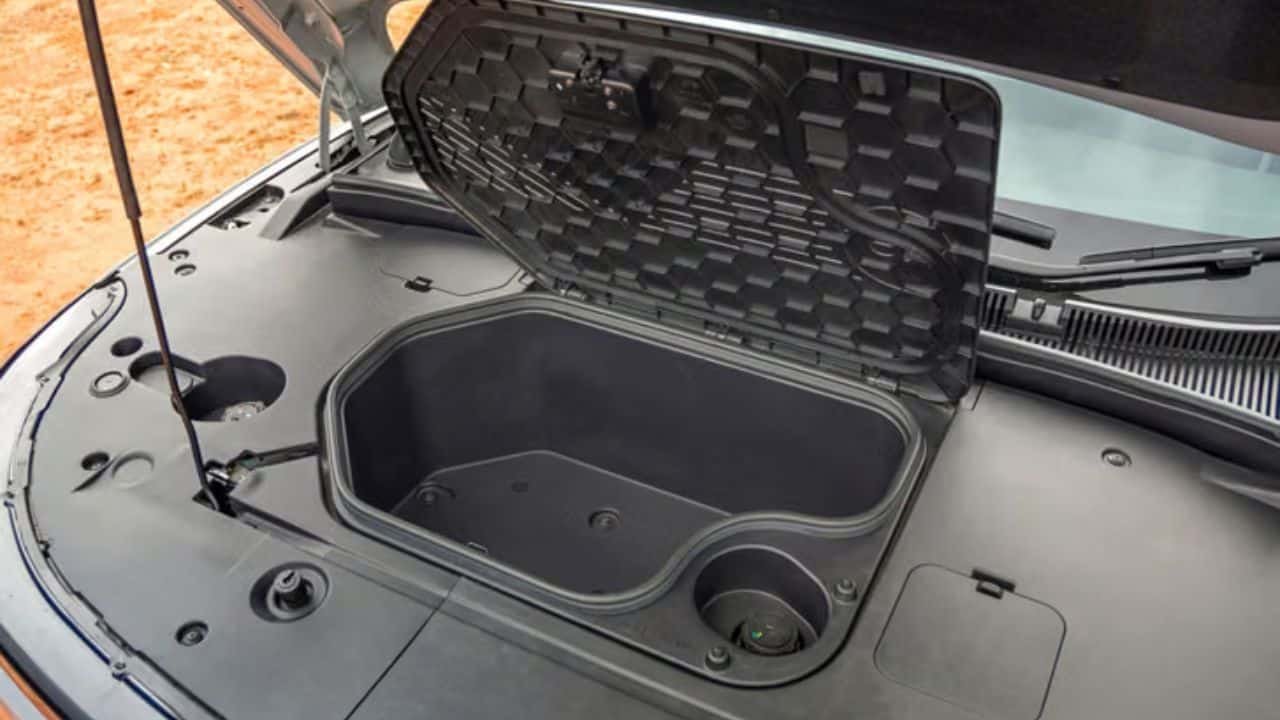

The Sierra EV gives you two separate storage areas instead of one, a 622-litre rear boot and a frunk up front, which is a genuine practical advantage over a conventional petrol SUV that only has the one. There’s a trade-off buried in that number worth knowing before you buy, though, and it’s not something every dealer volunteers upfront.
The Rear Boot: 622 Litres, Floor to Roof
The Sierra EV’s rear boot measures 622 litres, floor to roof, with all seats up, and that figure holds regardless of which battery pack or variant you pick, since Tata’s C2P (cell-to-pack) battery packaging keeps the cells low and flat under the floor rather than eating into boot height the way some competing EVs do. Autocar India’s review specifically called this out as an advantage over the Harrier EV, which uses a more conventional battery arrangement that does intrude somewhat more on interior packaging.
With the 60:40 split rear seats folded down, that capacity opens up to roughly 1,257 litres, enough for genuinely large cargo, flat-pack furniture, a bicycle with the front wheel off, or a full house-move’s worth of boxes for a small apartment. The split-fold mechanism means you don’t have to sacrifice all rear seating to get that space either, fold down just one side and you can still carry a passenger in the back while hauling something long through the other half of the boot.
The powered gesture tailgate opens with a foot-swipe under the rear bumper, which matters more in practice than it sounds. Arriving home with both hands full of groceries or wrangling a toddler and a stroller at the same time is exactly the scenario where not having to set something down to open the boot manually earns its keep, day after day, not just as a showroom party trick.
🚀 Join Our Tech Community!
Get the latest news, updates, and tech trends delivered straight to your phone. Never miss an update!
The Frunk: A Genuine Bonus, With a Catch
Because the Sierra EV is a purpose-built EV rather than a converted ICE platform, there’s usable space up front where a petrol engine would normally sit. On rear-wheel-drive, single-motor variants, that frunk measures 55 litres, big enough for a charging cable, a small soft bag, or a couple of grocery bags kept separate from anything in the main boot. On the all-wheel-drive (QWD) variant, the front motor takes up some of that space, cutting frunk capacity down to 35 litres.
That’s a genuine trade-off worth factoring into your variant decision if frunk space specifically matters to you: choosing AWD for its extra traction and performance comes at the direct cost of roughly a third less front storage. Neither figure is enormous by frunk standards globally, but both are large enough to be genuinely useful for keeping messy or wet items, like a charging cable pulled straight off a public charger, out of the main cabin and boot.
The One Real Trade-Off: No Spare Tyre
Here’s the part worth knowing before you’re stuck on a highway with a puncture: the Sierra EV doesn’t carry a spare wheel. Fitting the battery pack under the floor meant losing the space where a spare tyre would traditionally sit, and Tata has gone with a puncture repair kit instead, standard practice across a growing number of EVs, but still a meaningful change for anyone used to a full-size or even a compact spare in their current car.
A puncture repair kit handles a straightforward tread puncture reasonably well, but it won’t help with a sidewall tear or a badly damaged wheel, situations where a real spare is the only fix. If you regularly drive routes with poor road surfaces, unpaved stretches, or areas where roadside assistance response times are genuinely long, it’s worth factoring this into your decision, or at minimum, keeping your roadside assistance number saved and understanding exactly what the repair kit can and can’t fix before you need it in a hurry.
Cabin Storage: The Small Stuff That Adds Up
Beyond the two main cargo areas, the cabin itself is reasonably well thought out for everyday odds and ends. The glovebox is cooled, genuinely useful in Indian summer for keeping medicines, snacks, or anything else that shouldn’t bake in a hot cabin all day. Both front and second-row seats get Type-C charging outlets, so device charging doesn’t turn into a fight over the one available port the way it can in older cars. There’s a fixed front armrest with its own storage, door pockets sized for bottles, and a reasonable set of cupholders front and back.
None of this is dramatically different from what most modern SUVs in this segment offer, but it’s worth noting because it’s the kind of daily-use storage that gets used constantly, far more often than the boot itself, and the Sierra EV doesn’t cut corners here to save cost elsewhere.
Real-World Use Cases
For a weekly grocery run, the frunk alone comfortably handles a couple of bags, leaving the main boot free for anything bulkier, useful if you’re stopping somewhere else on the way home and don’t want groceries rolling around next to other cargo. For an airport drop-off with luggage, the 622-litre boot swallows two or three mid-size suitcases without needing to fold any seats, with the frunk as backup space for a laptop bag or duffel you’d rather keep separate. For a weekend trip with camping or sports gear, folding one side of the rear seats down while still carrying a passenger on the other side is the kind of flexibility a single-boot petrol SUV can’t always match as cleanly.
Frequently Asked Questions
How big is the Tata Sierra EV’s boot?
622 litres with all seats up, measured floor to roof, expanding to roughly 1,257 litres with the 60:40 split rear seats folded down.
Does the Tata Sierra EV have a frunk?
Yes. Rear-wheel-drive, single-motor variants get a 55-litre frunk, while the all-wheel-drive (QWD) variant gets a smaller 35-litre frunk, since the front motor takes up some of that space.
Does the Tata Sierra EV come with a spare tyre?
No. Fitting the battery pack under the floor meant Tata dropped the spare wheel in favour of a puncture repair kit, which handles simple tread punctures but not sidewall damage or a badly damaged wheel.
Is the Tata Sierra EV’s boot bigger than the Harrier EV’s?
The Sierra EV’s boot retains its full 622-litre capacity without the battery pack intruding on space, an advantage attributed to its cell-to-pack battery packaging, whereas the Harrier EV’s more conventional battery arrangement affects packaging somewhat more, according to Autocar India’s review.