
Ask a dealer whether you need ABS on your next motorcycle and you’ll usually get a confident yes, sometimes because it’s genuinely good advice, sometimes because it’s the pricier variant they’d rather sell you. The honest answer sits somewhere more specific: ABS is a genuinely valuable safety feature, but understanding exactly what it does, and what it doesn’t, helps you decide how much weight to give it against everything else on a spec sheet.
What ABS Actually Does
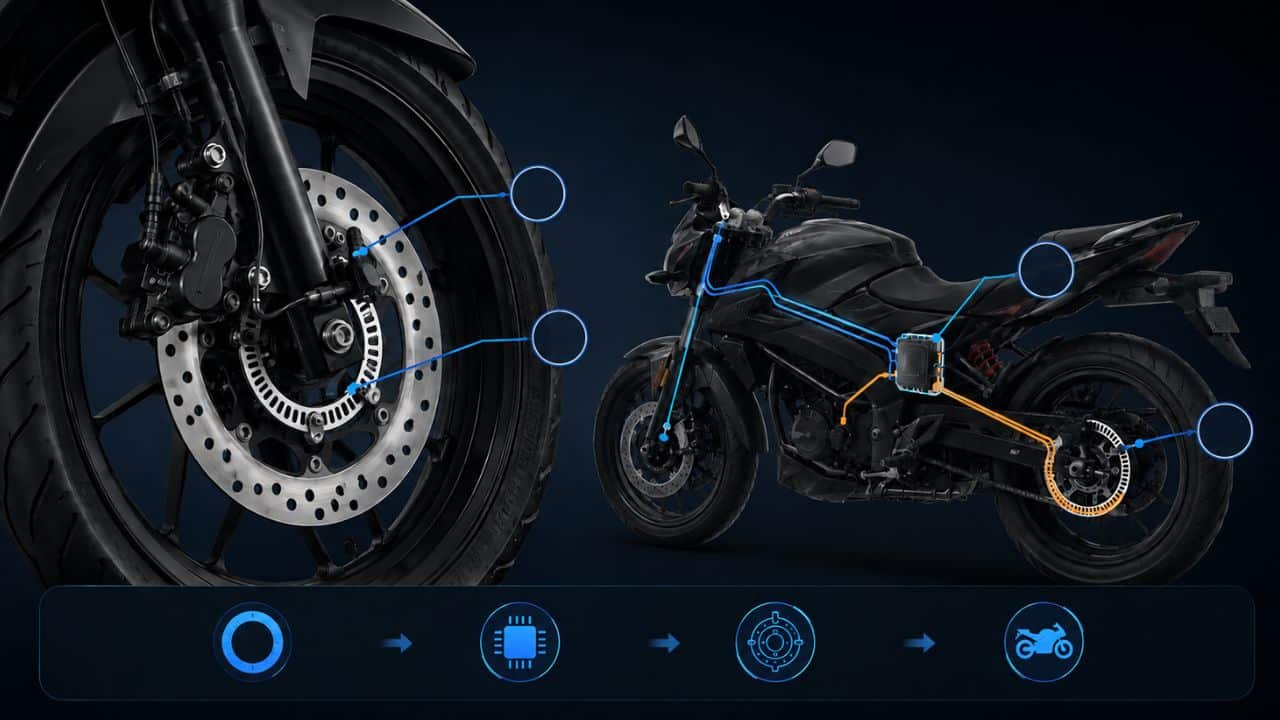
Anti-lock Braking System, ABS, prevents a motorcycle’s wheels from locking up completely during hard braking. Wheel speed sensors detect when a wheel is about to stop rotating faster than the vehicle is actually decelerating, a sign it’s about to skid, and the system rapidly modulates brake pressure to that wheel, releasing and reapplying it many times per second, to keep the tyre gripping the road instead of sliding.
The practical result is that a rider can apply the brakes hard, even in a genuine panic-stop situation, without the wheel locking, skidding, and potentially causing a loss of balance or a fall. This matters more on two wheels than on four, since a car with a locked wheel skids but generally stays upright, while a motorcycle with a locked front wheel very often doesn’t.
What ABS Doesn’t Do
ABS doesn’t shorten stopping distance in every single scenario, and it doesn’t replace good braking technique or road awareness. On a dry, grippy road, a skilled rider using both brakes correctly can sometimes stop in a similar distance with or without ABS. Where ABS earns its reputation is specifically in the situations riders can’t fully control or predict, wet roads, gravel or sand patches, sudden panic braking where instinct overrides technique, all conditions where a locked wheel is far more likely without the system intervening.
🚀 Join Our Tech Community!
Get the latest news, updates, and tech trends delivered straight to your phone. Never miss an update!
It also doesn’t prevent every kind of crash. Cornering-related losses of control, running wide on a bend, misjudging a turn’s radius, aren’t something standard ABS addresses, since it’s specifically a braking-event technology, not a general stability or handling system.
ABS vs CBS: The Two Systems You’ll See in India
CBS (Combined Braking System) links the front and rear brakes so that applying one lever or pedal distributes braking force to both wheels in a pre-set ratio, rather than requiring the rider to manually balance front and rear braking themselves. This helps riders who might otherwise brake with only the rear (a common instinct that produces weaker, less controlled stopping) get more balanced, effective braking automatically. CBS is mechanically simpler and cheaper to fit than ABS, which is why it’s long been the standard fitment on lower-cc commuter motorcycles and scooters in India.
ABS goes a step further by actively preventing wheel lockup during hard braking, something CBS on its own doesn’t do. A bike can have CBS without ABS, and this remains a common setup on sub-125cc commuters in India, where ABS has historically not been mandatory.
The two aren’t interchangeable safety claims. CBS improves how braking force is distributed, ABS specifically prevents the skid that a locked wheel causes. A bike advertised as having “CBS” is not the same safety proposition as one with ABS, even though both terms show up in similar marketing contexts.
The Current Regulatory Picture in India
As things stand, ABS has been mandatory on two-wheelers above 125cc in India since 2019, while smaller-displacement models have been permitted to use CBS instead. There has been an active government proposal to extend mandatory ABS to all two-wheelers regardless of engine size, but manufacturers have raised cost and implementation concerns, and reports through late 2025 and into early 2026 pointed toward a likely delay or reconsideration of that expanded mandate rather than a confirmed rollout. Because this regulatory picture has been actively shifting, always check the current, confirmed rule at the time you’re buying rather than relying on any single article, including this one, for the latest status.
Practically, this means at the time of writing, several sub-125cc motorcycles in India still ship with CBS rather than full ABS, though ABS is increasingly offered as an available option or standard fitment on higher trims even in this displacement bracket, well ahead of any regulatory requirement to do so.
Single-Channel vs Dual-Channel ABS
Where a bike does have ABS, it’s worth knowing there are two common configurations. Single-channel ABS applies the anti-lock function to the front wheel only, the wheel most critical to stopping power and most prone to a dangerous lockup. Dual-channel ABS applies it to both wheels, offering more complete protection against skidding under hard braking on either end of the bike.
Dual-channel systems are more common on higher-displacement and performance-oriented motorcycles, while single-channel ABS remains a common, more affordable middle ground on smaller commuter and entry-level performance bikes that do offer ABS.
Is ABS Actually Worth Paying Extra For?
For most riders, yes, and the reasoning is straightforward: Indian road and weather conditions, unpredictable traffic, sudden monsoon rain, gravel and debris on poorly maintained stretches, create exactly the unpredictable braking scenarios where ABS delivers its biggest safety benefit. A rider who commutes daily through city traffic, where sudden hard braking is a near-daily occurrence rather than a rare emergency, benefits from ABS more consistently than someone who rides occasionally on quiet, predictable roads.
The trade-off is cost. ABS variants typically carry a real price premium over their CBS or non-ABS counterparts, and for a genuinely budget-constrained first-time buyer, that premium competes directly against other priorities, insurance affordability, a better-riding-position variant, or simply staying within a hard budget ceiling. There’s no universally correct answer here, but for a rider who can stretch to afford it, ABS is one of the more consistently valuable safety upgrades available on a motorcycle spec sheet.
ABS is one of the clearer, more evidence-backed safety upgrades available on a modern motorcycle, and it earns that reputation specifically in the unpredictable, high-stakes braking moments that Indian riding conditions produce regularly. It’s not a substitute for good riding technique, road awareness, or basic maintenance, and CBS remains a genuine, if lesser, safety improvement where ABS isn’t available or affordable. If your budget allows the step up, it’s a feature worth prioritizing over most cosmetic or convenience upgrades on a spec sheet.
Frequently Asked Questions
Does ABS make a motorcycle stop faster in every situation?
Not necessarily on a dry, clean road with a skilled rider braking correctly. ABS’s real advantage shows up specifically in unpredictable conditions, wet roads, gravel, sudden panic braking, where a locked wheel is much more likely without it, and where the consequences of a lockup are more severe on two wheels than four.
Is CBS a safe enough alternative to ABS for a budget commuter?
CBS genuinely improves braking balance and helps prevent the common mistake of relying only on the rear brake, and it’s a meaningful safety improvement over having neither system. It doesn’t replace ABS’s specific ability to prevent wheel lockup during hard braking, so a bike with only CBS carries more skid risk in an emergency stop than an equivalent bike with ABS.
Should I pay extra for dual-channel ABS over single-channel?
If your budget allows it, dual-channel ABS offers more complete protection since it covers both wheels rather than just the front. For a budget-conscious buyer, single-channel ABS, which covers the front wheel where lockup risk and consequences are typically greatest, is still a meaningful safety upgrade over no ABS at all.