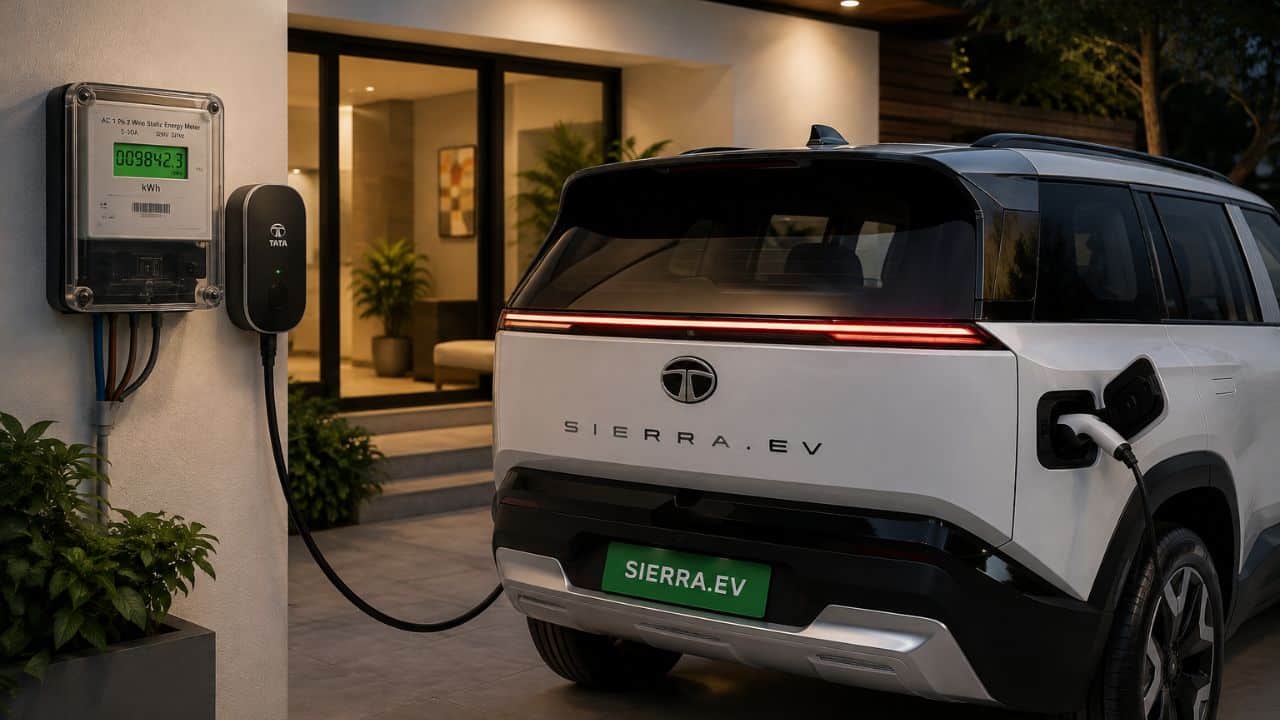

Home-charged and driven sensibly, the Sierra EV works out to somewhere around ₹1 to ₹1.5 per kilometre, depending on your local electricity tariff. Lean on public DC fast chargers regularly instead, and that number climbs noticeably higher. Here’s how to work out your own real cost per km, rather than relying on a single brochure figure that may not match your actual usage.
How to Actually Calculate It
Running cost per km comes down to one simple formula: your electricity tariff per unit (kWh), divided by how many kilometres you get per kWh of that electricity. The tricky part isn’t the maths, it’s getting an honest efficiency number, since brochure and real-world figures diverge more than most buyers expect.
Tata’s own EV lineup, including the Sierra EV, was rated among the most efficient in the world in the International Council on Clean Transportation’s 2025 automaker efficiency rating, with an average of around 106 Wh/km across the brand’s electric range on official test-cycle figures, ahead of Tesla and BYD on the same metric. That’s a strong number on paper. Real-world efficiency will run higher than that, though, once you factor in AC use, highway speeds, and stop-start traffic.
An independent real-world test on the top-spec 75 kWh AWD Sierra EV, driven Coimbatore to Chennai and back over roughly 1,000 km, returned a real-world range of 466 to 546 km per full charge depending on conditions, cooler night driving with a slight downhill gradient landed at the higher end, hot daytime driving with continuous AC use landed at the lower end. That works out to real-world efficiency somewhere in the range of 137 to 161 Wh/km on that particular AWD variant, noticeably higher than the official test-cycle number, which is exactly what you’d expect once real conditions replace a controlled test cycle.
🚀 Join Our Tech Community!
Get the latest news, updates, and tech trends delivered straight to your phone. Never miss an update!
Cost Per KM at Different Charging Rates
| Charging method | Typical tariff | Approx. cost per km* |
|---|---|---|
| Home charging, low domestic slab | ₹6-8/unit | ₹0.80-1.05 |
| Home charging, standard domestic slab | ₹8-10/unit | ₹1.05-1.35 |
| Public AC charging | ₹10-14/unit | ₹1.35-1.90 |
| Public DC fast charging | ₹15-20/unit | ₹2.00-2.70 |
Based on a real-world efficiency range of roughly 140-150 Wh/km. Your actual tariff and efficiency will vary by state, time of use, driving style, and variant, so treat this table as a working estimate rather than a fixed number for your specific setup.
One already-calculated reference point is worth mentioning here: assuming an average of 60 km driven per day and an electricity price of ₹10 per unit, the Sierra EV’s running cost on the 63 kWh variant has been estimated at around ₹1.11 per km. That lines up reasonably well with the table above once you account for the specific tariff and efficiency assumptions behind it.
How the Sierra EV Compares to a Petrol SUV
A petrol SUV in the same size and price bracket typically returns somewhere in the 12-15 kmpl range in real-world city and highway driving, and with petrol prices generally sitting around ₹100-105 per litre in most Indian metros as of this writing, that works out to a running cost of roughly ₹6.50-8.50 per km. Against that, even the Sierra EV’s public DC fast-charging cost of ₹2-2.70 per km comes in well below petrol, and home charging at a standard domestic slab cuts that gap even further, down to somewhere between a sixth and an eighth of what an equivalent petrol SUV costs to run per kilometre.
This is where most of the Sierra EV’s long-term ownership case is actually made. The upfront price gap over a comparable petrol SUV narrows meaningfully once you’re covering real daily or monthly distances, especially for owners who do most of their charging at home rather than relying on public fast chargers.
What Actually Pushes Your Running Cost Up
Public fast charging as your main method: Relying on DC fast charging for routine daily top-ups instead of home charging is the single biggest thing that erodes the Sierra EV’s cost advantage, since public DC tariffs run noticeably higher than home domestic rates.
Constant AC use in summer: Running the AC continuously in Indian summer heat, especially at highway speeds, adds a real efficiency penalty, and it’s the main reason the real-world test above saw its lowest range on the hot daytime leg of the drive.
Aggressive driving and high cruising speeds: Like any EV, the Sierra EV’s efficiency drops noticeably at sustained highway speeds compared to gentler city driving, since aerodynamic drag becomes the dominant factor working against the motor at higher speed.
Cold-weather driving: Less of a factor across most of India than in colder climates, but in hill stations or winter mornings in the north, expect a modest efficiency hit until the battery and cabin warm up.
Underinflated tyres: As with any vehicle, running tyres below the recommended pressure increases rolling resistance and quietly drags down efficiency over time, and it’s one of the easiest and cheapest things to check regularly.
Frequently Asked Questions
What is the running cost per km of the Tata Sierra EV?
Roughly ₹1 to ₹1.5 per km when charged at home on a standard domestic electricity tariff, based on real-world efficiency figures. Relying mainly on public DC fast charging pushes this to roughly ₹2-2.70 per km.
Is the Tata Sierra EV cheaper to run than a petrol SUV?
Yes, substantially. A comparable petrol SUV typically costs roughly ₹6.50-8.50 per km to run at current fuel prices, meaning the Sierra EV’s home-charging running cost can be a sixth to an eighth of that figure.
Does AC use significantly affect the Sierra EV’s running cost?
Yes. Independent real-world testing showed a noticeably lower range on a hot daytime drive with continuous AC use compared to a cooler night drive on the same route, which directly increases cost per km for that usage pattern.
Is Tata Sierra EV’s official efficiency figure accurate for real-world use?
The Sierra EV’s official test-cycle efficiency (part of a Tata EV fleet average of about 106 Wh/km in ICCT’s 2025 rating) is a controlled-condition number. Real-world testing on the AWD variant showed meaningfully higher energy consumption, which is expected once traffic, AC use, and driving style are factored in.