
For many first-time electric car buyers in India, one question dominates the decision-making process: Is home charging alone enough for daily use, or will public chargers be necessary?
This concern is practical, not theoretical. Most Indian cities have limited public charging density, and daily routines are often unpredictable. This guide looks at real daily usage patterns to understand whether home charging is sufficient for most EV owners.Is owning Electric Cars is better or not?
Understanding Daily Driving in Indian Cities
Urban driving in India is typically short-distance but frequent. Office commutes, school runs, shopping trips, and short errands make up the bulk of daily usage.
For most city users:
- Daily driving ranges between 20–50 km
- Vehicles remain parked overnight for long hours
- Driving speeds are low to moderate
Electric cars are particularly efficient in such conditions because regenerative braking and stop-start traffic work in their favour.
How Much Range Do You Actually Use Daily?
Most electric cars available in India offer usable real-world ranges that comfortably exceed daily city needs.
If an EV delivers even conservative real-world range, it still covers multiple days of city driving on a single charge. This means daily charging is not a requirement, but a convenience.
In practice, many owners treat EV charging like phone charging:
- Plug in when parked
- Unplug when needed
- No stress about exact percentages
Overnight Charging: The Real Advantage
Home charging works because cars remain unused for long stretches overnight. Even a slow home charger can replenish significant range during this time.
Key advantages of overnight charging:
- No waiting time
- No queues
- Predictable daily readiness
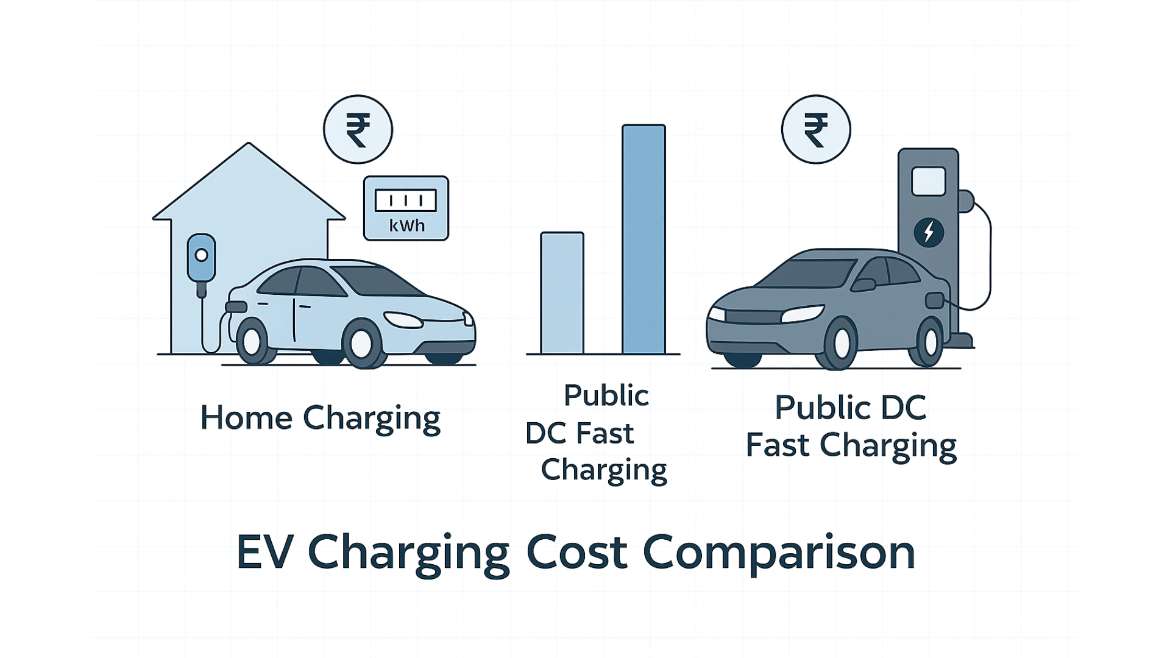
- Lower electricity cost compared to public chargers
For daily city use, overnight charging quietly solves the energy requirement without disrupting routine.
Apartment Living vs Independent Homes
Charging access varies based on housing type.
Independent houses
- Usually have straightforward charging installation
- Dedicated parking space simplifies setup
- Least dependency on public charging
Apartment buildings
- Charging depends on society permission
- Shared parking can complicate installation
- Still manageable with fixed parking slots
Even in apartments, many users rely almost entirely on home charging once infrastructure is set up.
What Happens If You Skip Charging for a Day?
One common misconception is that electric cars must be charged every night. In reality, skipping a day or two rarely creates a problem for city users.
Most EV owners charge:
- Every 2–3 days
- When battery drops to a comfortable level
- Based on routine, not urgency
This flexibility makes EV ownership less demanding than many first-time buyers expect.
Role of Public Charging in Daily Life
Public charging is not useless, but its role is often misunderstood.
For city users, public chargers are typically used:
- Occasionally, not daily
- As backup, not primary supply
- During long or unplanned driving days
Relying entirely on public charging for daily use is inconvenient, but using it as a safety net works well.
Electricity Load and Safety at Home
Home charging does not significantly strain household electricity if installed correctly.
Important factors:
- Dedicated circuit
- Proper earthing
- Load management by electrician
Once installed, charging becomes a background activity rather than a daily concern.
Real-World Ownership Pattern
Most Indian city EV owners follow a simple routine:
- Charge at home
- Drive daily without monitoring constantly
- Use public chargers only when necessary
This pattern closely mirrors petrol car usage, except refuelling happens at home instead of fuel stations.
Who Might Need More Than Home Charging?
Home charging alone may feel insufficient if:
- Daily driving consistently exceeds city averages
- Parking access is unpredictable
- Home installation is not encouraging
Even then, home charging still covers a large portion of usage, with public charging filling the gap.
Final Perspective
For most Indian city drivers, home charging is more than enough for daily EV use. It offers convenience, predictability, and low running cost. Public charging should be viewed as a supplement, not a dependency.
The real shift with EVs is not range it is mindset. Once home charging becomes routine, daily usage anxiety fades quickly.

2 thoughts on “Is Home Charging Enough for Daily EV Use in Indian Cities?”