

The idea that electric cars are cheap to run is often repeated, but for Indian buyers, the real question is more practical: does an EV actually reduce monthly and yearly expenses compared to petrol or diesel cars?
The answer depends less on headlines and more on how Indian households use their cars day to day.
This breaks down running costs in real terms electricity, charging habits, service needs, and everyday usage so you can judge whether an EV makes financial sense for your situation.
Understanding “Running Cost” in the Indian Context
When buyers talk about running cost, they usually mean three things:
- Energy cost per kilometre
- Routine service and wear items
- Day-to-day ownership expenses (not purchase price)
For Indian conditions mixed city traffic, short commutes, and rising fuel prices energy cost plays the biggest role.
🚀 Join Our Tech Community!
Get the latest news, updates, and tech trends delivered straight to your phone. Never miss an update!
Electricity Cost vs Petrol and Diesel
Electricity is the main reason EV running costs are lower.
Most EV owners charge at home using domestic electricity. Even with higher urban tariffs, the per-unit cost remains significantly lower than petrol or diesel.
In practical terms:
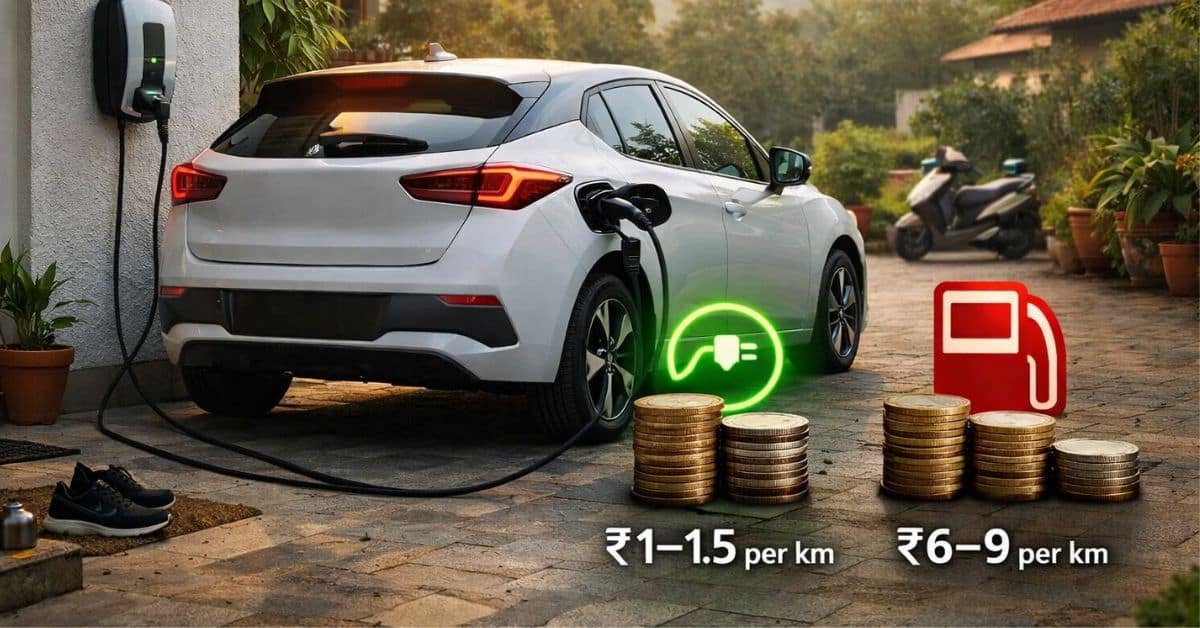
- An electric car typically consumes electricity worth ₹1–₹1.5 per km when charged at home
- A petrol car often costs ₹6–₹9 per km, depending on fuel price and mileage
- Diesel cars usually fall slightly lower than petrol, but still much higher than EVs
This gap becomes more visible as monthly usage increases.
Monthly Driving: Where EV Savings Become Clear
For low usage, savings exist but feel modest.
For regular commuters, the difference becomes noticeable.
Typical Indian usage patterns:
- 30–40 km daily city driving
- 800–1,200 km per month
At these levels, EV owners often spend one-fourth to one-sixth of what petrol car owners spend on fuel.
The more you drive, the faster this advantage compounds.
Home Charging vs Public Charging Costs
Home charging keeps EV running costs low.
Public charging changes the equation slightly.
- Home charging: Cheapest and most predictable
- Public AC charging: Moderately priced, still cheaper than petrol
- Public DC fast charging: Costs more, sometimes close to petrol per-km levels
Most private EV owners rely on home charging for daily use and treat fast chargers as an occasional backup. When public charging becomes the primary source, overall savings reduce but rarely disappear completely.
Service and Maintenance Expenses
Electric cars have fewer moving parts than internal combustion vehicles. This directly affects running cost.
What EVs don’t need:
- Engine oil changes
- Gearbox servicing
- Clutch replacements
- Exhaust system repairs
What EVs still require:
- Tyres
- Brake pads (usually slower wear due to regenerative braking)
- Suspension and steering components
- Cabin filters and coolant checks
Annual service bills for EVs are generally lower and more predictable, especially during the first few years of ownership.
Battery Concerns and Long-Term Cost
Battery replacement is often cited as a hidden expense, but for most owners, it is not a short-term running cost.
Modern EV batteries are designed to last many years under normal usage. Gradual capacity reduction happens, but it does not immediately translate into replacement.
For everyday running cost calculations:
- Battery cost does not affect monthly expenses
- Charging efficiency remains largely stable for years
- Real impact appears only over long ownership periods
This makes EV running costs easier to manage month to month.
City Driving vs Highway Driving
EVs are especially cost-effective in cities.
- Stop-and-go traffic favours regenerative braking
- Low speeds improve efficiency
- Frequent short trips suit home charging routines
On highways, energy consumption increases, but the per-km cost usually remains lower than petrol unless fast charging is used extensively.
For users with mostly urban driving, EV savings are strongest.
Rising Fuel Prices vs Stable Electricity Rates
One overlooked factor is price volatility.
- Petrol and diesel prices fluctuate frequently
- Electricity tariffs change slowly and predictably
This stability helps EV owners plan monthly budgets more confidently. Over time, fuel price increases widen the running-cost gap even further.
When an EV May Not Feel Cheaper to Run
Despite clear advantages, EVs may not feel significantly cheaper if:
- Monthly driving is very low
- Public fast charging is used frequently
- Home charging is unavailable
- The vehicle is rarely driven beyond short distances
In such cases, savings exist but may not feel dramatic in everyday life.
The Real Answer for Indian Buyers
Electric cars are genuinely cheaper to run in India for most regular drivers, especially those with access to home charging and consistent monthly usage.
The savings are not theoretical they show up in:
- Lower monthly energy bills
- Reduced service expenses
- Predictable ownership costs
The key is not how advanced the EV is, but how well it fits your daily routine.