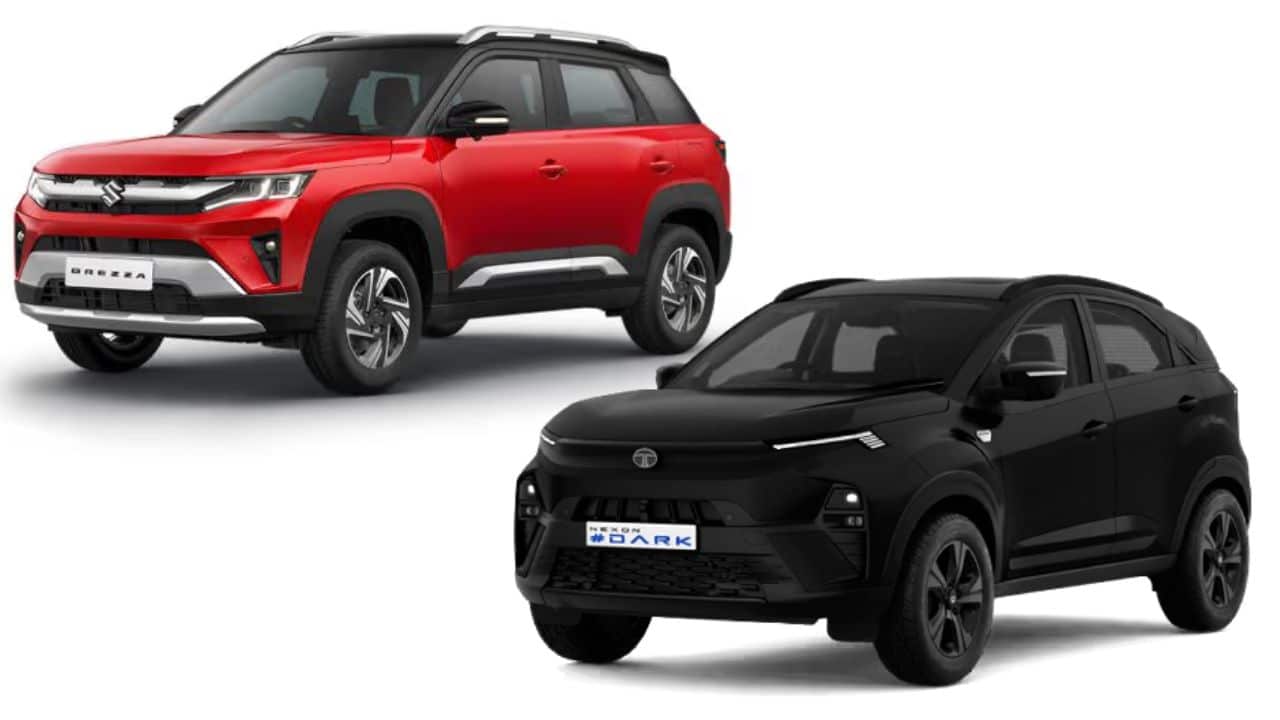

A quick fact-check before this comparison: as of publishing, Tata has not launched a facelift or new-generation Nexon. The current Nexon on sale is the 2023 facelift, which remains the version being compared here. A genuinely new-generation Nexon, reportedly codenamed “Garud,” is expected only toward late 2026 or into 2027, and its specifications, pricing, and features are not yet officially confirmed. If you’ve seen “Nexon Facelift 2026” referenced elsewhere, it’s most likely describing this same existing 2023-facelifted car, or speculative reporting on the unlaunched next-generation model. This article compares the new Brezza against the Nexon that’s actually available in showrooms today.
The Two Cars at a Glance
| Factor | Maruti Brezza 2026 | Tata Nexon (current) |
|---|---|---|
| Ex-showroom price range | ₹7.40 lakh – ₹13.01 lakh | ₹7.40 lakh – ₹14.30 lakh |
| Petrol engine | 1.0L Boosterjet turbo (110 PS/170 Nm) or 1.5L NA (103 PS/139 Nm) | 1.2L turbo-petrol (up to 118-120 PS/170 Nm) |
| Diesel option | No | Yes, 1.5L (115 PS/260 Nm) |
| CNG option | Yes, manual only | Yes, manual only |
| Transmission choices | 6-speed MT, 6-speed AT | 5-speed MT, 6-speed MT, 6-speed AMT, 7-speed DCT |
| Safety rating | 5-star Bharat NCAP | 5-star Bharat NCAP and 5-star Global NCAP |
| Standard airbags | 6, across all variants | 6, across all variants |
| Boot space | 328 litres | 382 litres |
| Ground clearance | 198 mm | 208 mm |
| ADAS | Not confirmed as standard | Level 1 ADAS on higher variants |
Powertrain: Where the Two Cars Genuinely Differ
This is the single biggest differentiator between them. The Brezza offers no diesel option at all, its lineup is turbo-petrol, naturally aspirated petrol, or CNG. The Nexon is the only car in this comparison that still offers diesel, alongside its own turbo-petrol and CNG options, making it the more relevant pick if you’re specifically a high-mileage, diesel-loyal buyer who wants that engine’s low-end torque for highway-heavy use.
On petrol, the two cars are closer than the badges suggest. The Brezza’s Boosterjet turbo makes 110 PS and 170 Nm, while the Nexon’s 1.2-litre turbo-petrol makes a comparable, sometimes slightly higher, output depending on the exact variant and source, typically cited between 118-120 PS with the same 170 Nm torque figure. In practical daily driving, both deliver a similar character: usable low-end torque that makes city overtaking and highway merging less strained than a naturally aspirated engine of similar size.
Transmission choice is where the Nexon pulls ahead on paper. It offers a 7-speed dual-clutch automatic in addition to a manual and an AMT, giving buyers who want a quick-shifting automatic an option the Brezza simply doesn’t have. The Brezza’s only automatic is a conventional torque converter unit paired with the naturally aspirated 1.5-litre, there’s no automatic gearbox available on its turbo-petrol at all, unlike the Nexon’s DCT-equipped turbo variants.
🚀 Join Our Tech Community!
Get the latest news, updates, and tech trends delivered straight to your phone. Never miss an update!
Safety: Both Are Genuinely Strong, With One Real Difference
Both cars carry 5-star Bharat NCAP ratings and 6 airbags as standard across their respective ranges, so neither is a compromise on core crash protection. The Nexon additionally holds a 5-star Global NCAP rating from its original testing cycle, and it has a longer track record on this front since it was among the first Indian-made cars to earn that international rating.
Where the Nexon currently has an edge is driver-assistance technology. It offers Level 1 ADAS features, including autonomous emergency braking, lane keep assist, and traffic sign recognition, on its higher variants, though it does not get adaptive cruise control. The Brezza’s advanced safety features, cruise control, blind-spot warning, rear cross-traffic alert, and TPMS, are real but are tied specifically to Boosterjet turbo variants from ZXi trim upward, and don’t reach the same breadth as a full ADAS suite. If autonomous braking and lane-keep assistance genuinely matter to you, the Nexon currently has the more developed offering.
Space and Practicality
The Nexon’s 382-litre boot space beats the Brezza’s 328 litres by a meaningful margin, useful if you regularly carry more luggage or travel as a larger family. Its 208 mm ground clearance also edges out the Brezza’s 198 mm, giving it slightly more comfort clearing speed breakers and moderately broken roads, though the difference is not large enough to be a deciding factor on its own for most buyers.
Running Costs and CNG
Both cars offer CNG on a manual-only basis, so neither gives you an automatic CNG option. The Nexon’s CNG variant makes a lower power figure in CNG mode, cited around 99 PS, which is worth knowing if outright drivability on CNG matters to you. The Brezza’s redesigned underbody CNG tank, carried over from the Victoris, is a genuine practicality improvement over its own outgoing boot-mounted design, and is worth checking against how the Nexon’s CNG tank is packaged if boot space specifically on CNG variants is a priority.
For diesel buyers specifically, the Nexon remains the only option between these two, since the Brezza doesn’t offer a diesel engine at all. If your monthly running is high enough that diesel’s efficiency advantage matters, that alone may settle the comparison in the Nexon’s favour regardless of other factors.
Price Comparison
Both cars start at an identical ₹7.40 lakh ex-showroom at the base variant, so neither has a clear advantage at the entry point. At the top end, the Nexon’s ₹14.30 lakh ceiling runs somewhat higher than the Brezza’s roughly ₹13.01 lakh, though this partly reflects the Nexon’s wider engine and transmission spread, including its diesel and DCT options, which the Brezza doesn’t offer at any price point.
Which Should You Buy?
Choose the Brezza 2026 if you want the newer of the two designs with a genuinely fresh turbo-petrol engine, don’t need diesel, and are drawn to Maruti’s typically lower long-term maintenance costs and wider service network reach, particularly relevant in smaller towns where Maruti’s presence often runs deeper than Tata’s.
Choose the Nexon if diesel is a requirement, if you want the option of a 7-speed DCT automatic on a turbo-petrol, if boot space and ground clearance genuinely matter for your use case, or if Level 1 ADAS features like autonomous emergency braking are a priority you’re not willing to compromise on.
Neither car is a clearly wrong choice, this comparison comes down to specific priorities rather than one car being categorically better. Test-drive both, and if diesel or ADAS matter to you, that alone may settle the decision before price or styling even enter the picture.
Frequently Asked Questions
Has Tata launched a Nexon facelift in 2026?
No. As of publishing, the Nexon on sale remains the 2023 facelift. A next-generation model, reportedly codenamed “Garud,” is expected only toward late 2026 or 2027, with specifications not yet officially confirmed.
Does the Tata Nexon offer diesel while the Brezza doesn’t?
Yes. The Nexon offers a 1.5-litre diesel engine, an option the Brezza 2026 does not have in any variant or trim.
Which has better safety features, the Brezza or the Nexon?
Both carry 5-star Bharat NCAP ratings with 6 airbags standard. The Nexon currently offers Level 1 ADAS features like autonomous emergency braking on higher variants, which the Brezza’s current lineup doesn’t match in breadth.
Which has more boot space, Brezza or Nexon?
The Nexon offers 382 litres of boot space, more than the Brezza’s 328 litres.