
Electric cars are often described as low maintenance, but what does that actually mean for an Indian owner over years of use? Buyers switching from petrol or diesel cars usually want clarity on service frequency, parts that wear out, and whether EV maintenance is truly simpler or just marketed that way.
How much maintenance an electric car really needs in India, based on ownership realities rather than brochures.
Why EV maintenance is fundamentally different
Electric vehicles do not rely on engines with hundreds of moving parts. There is no engine oil, clutch, gearbox, timing belt, or exhaust system. That single difference removes many routine service items that Indian car owners are used to budgeting for every year.
Instead, EV maintenance revolves around three core systems:
🚀 Join Our Tech Community!
Get the latest news, updates, and tech trends delivered straight to your phone. Never miss an update!
- Battery pack and thermal management
- Electric motor and power electronics
- Chassis, suspension, brakes, and tyres
Understanding these areas helps set realistic expectations.
Service intervals: what actually happens at the service center
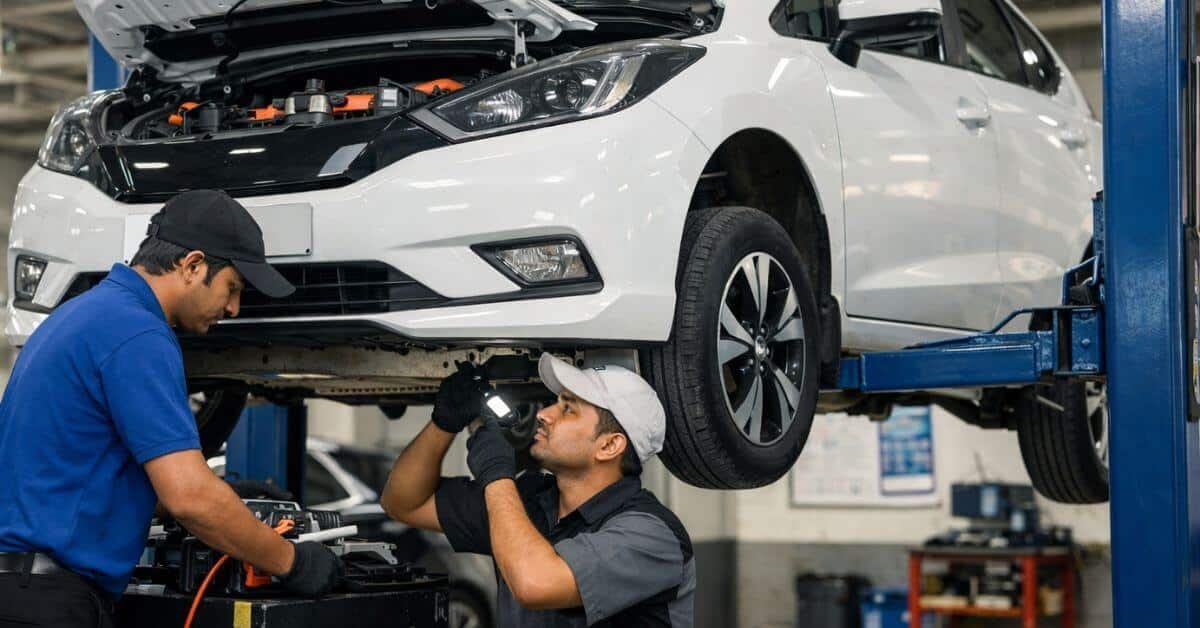
Most EVs sold in India follow annual or 10,000–15,000 km inspection cycles, whichever comes first. Unlike ICE cars, these visits are largely inspection-focused rather than replacement-heavy.
Typical EV service checks include:
- Battery health diagnostics and software scan
- Cooling system inspection for battery and motor
- Brake inspection and cleaning
- Suspension and steering check
- Tyre rotation, alignment, and balancing
- Cabin air filter replacement if needed
In many cases, owners leave the service center without any major part being replaced.
Battery maintenance: what owners need to know
The battery is the most valuable component, yet it requires very little physical maintenance from the owner. There is no routine opening or cell replacement during normal ownership.
What matters instead:
- Battery management software updates
- Cooling system health
- Charging habit consistency
Indian conditions—heat, dust, and stop-go traffic—make cooling system checks important. However, these are inspections, not recurring expenses.
Battery degradation is gradual, not sudden. For most owners, battery health checks during annual service are enough to monitor long-term condition.
Brake wear is lower than expected
EVs use regenerative braking, which slows the car by using the motor instead of brake pads whenever possible. This leads to:
- Slower brake pad wear
- Longer disc lifespan
- Reduced brake servicing frequency
Many EV owners report brake pads lasting significantly longer than in equivalent petrol cars, especially in city usage.
However, periodic brake cleaning is still important due to dust accumulation, especially during monsoons.
Motor and electronics: low wear, high reliability
Electric motors are sealed units with minimal wear points. They do not require lubrication, tuning, or periodic adjustments.
Power electronics such as the inverter and onboard charger are also sealed and monitored by software. Service visits typically involve diagnostics rather than physical repairs unless there is an unexpected fault.
For owners, this translates into predictability rather than surprise expenses.
Tyres and suspension: similar to regular cars
One area where EVs do not differ much is tyres and suspension. In fact, EVs can be slightly harder on tyres due to instant torque and higher vehicle weight.
Owners should expect:
- Regular tyre rotations
- Slightly faster tyre wear if driven aggressively
- Normal suspension wear over time
These costs are comparable to petrol or diesel cars in the same size and weight category.
What EV owners do NOT pay for anymore
Over a 5-year period, EV owners typically avoid:
- Engine oil changes
- Oil filters and fuel filters
- Spark plugs
- Clutch replacements
- Gearbox-related servicing
- Exhaust repairs
These savings are consistent regardless of city or driving pattern.
Long-term maintenance outlook (5–8 years)
Beyond routine service, the main long-term considerations are:
- Suspension components due to road conditions
- Tyres
- Possible cooling system component replacement
Battery replacement is not a routine maintenance item and is generally a long-term ownership decision rather than a service requirement.
Is EV maintenance cheaper in India?
In most ownership scenarios, EV maintenance costs are lower and more predictable than petrol or diesel cars. The key difference is not zero maintenance, but fewer consumables and fewer mechanical failures.
For Indian buyers who value low service complexity and fewer workshop visits, EVs offer a tangible advantage.