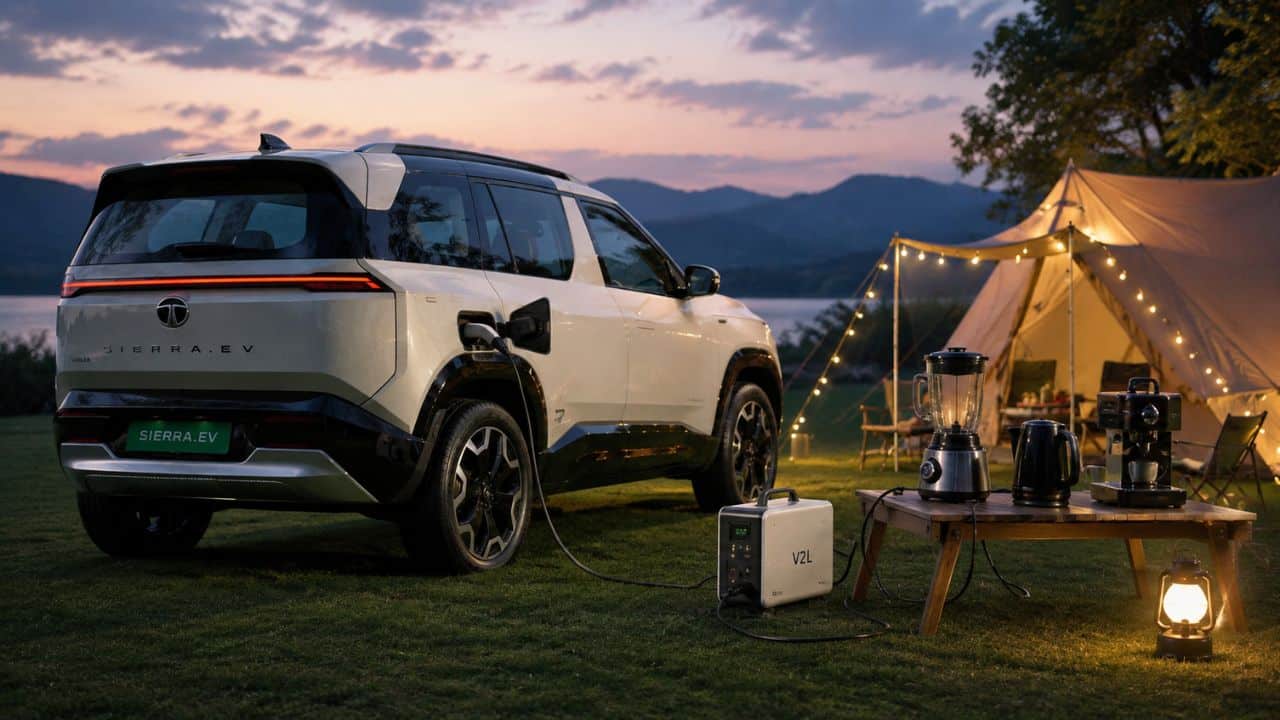

The Tata Sierra EV can do more than charge itself. On variants equipped with the feature, its battery can power external devices through Vehicle-to-Load (V2L) at up to 3.3kW, or top up another electric vehicle through Vehicle-to-Vehicle (V2V) at up to 5kW. Both draw from the same high-voltage battery pack that drives the car, just routed outward instead of to the motors.
What Is V2L on the Tata Sierra EV?
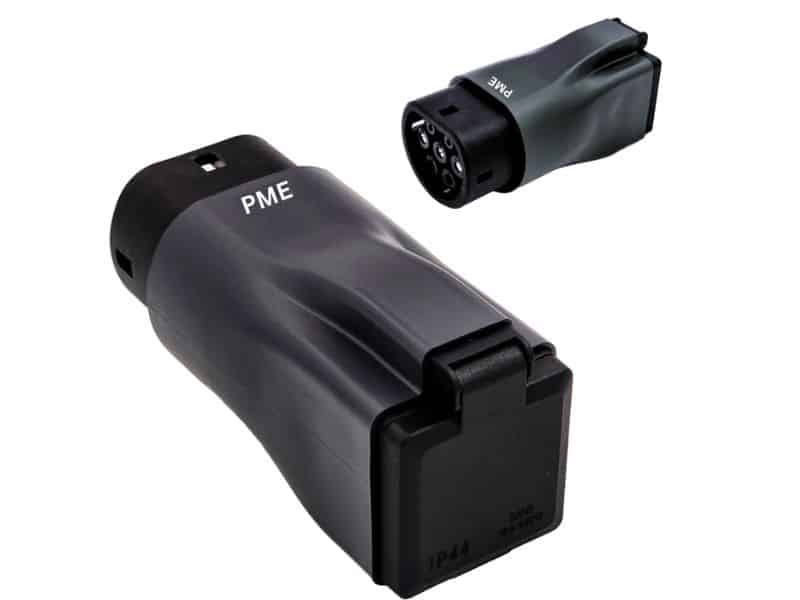
V2L turns the Sierra EV’s battery into a portable power source. Plug a compatible adapter into the vehicle’s charging port, and it outputs standard AC power, rated at 3.3kW, that you can run through an extension board or directly into an appliance.
That’s enough headroom to run most things a household or a campsite would need at once: a laptop and a few lights, a small induction cooktop, a projector for an outdoor movie night, or a portable cooler box. It won’t comfortably run something like a full-size air conditioner or a water heater continuously, those draw more sustained power than 3.3kW leaves room for alongside anything else plugged in.
For Indian buyers specifically, the more practical use case than camping is probably load-shedding. Parts of the country still deal with scheduled or unscheduled power cuts, and a Sierra EV with a reasonably charged battery can keep essential home circuits running for hours through V2L, functioning as a backup generator that doesn’t need diesel or need to be started.
🚀 Join Our Tech Community!
Get the latest news, updates, and tech trends delivered straight to your phone. Never miss an update!
What Is V2V, and When Would You Actually Use It?
V2V lets the Sierra EV transfer charge directly to another electric vehicle, rated at up to 5kW output. In practice, this means one Sierra EV with charge to spare can act as a mobile charging point for a second EV that’s run low, provided both vehicles support compatible V2V hardware.
The obvious use case is a breakdown. An EV stranded with a depleted battery on a highway, far from the nearest charging station, is a genuinely difficult situation, since towing an EV isn’t as simple as carrying a jerry can of petrol to a stranded ICE car. A Sierra EV pulling up and transferring 5kW of charge for even thirty to forty minutes could add enough range to limp to the next charging point. It’s also useful within a household or a small fleet running two Tata EVs, where one vehicle with a fuller battery can top up the other overnight without needing a second home charger.
Which Sierra EV Variants Get V2L and V2V?
V2L and V2V charging aren’t standard across the entire Sierra EV lineup. They’re available from the Pure S trim upward, meaning the base Pure variant misses out on both features. Buyers who specifically want bidirectional charging should check the variant sheet before booking, since it’s easy to assume a feature this prominently marketed comes on every trim when it doesn’t.
How Bidirectional Charging Actually Works
Every EV battery stores and releases direct current (DC). To power a household appliance or another vehicle’s AC-compatible input, that stored DC has to be converted to alternating current (AC), the same job the car’s onboard inverter already does to run its own electric motor, just directed outward through a different port.
This is why V2L and V2V require specific hardware support built into the vehicle from the factory, and why not every EV on Indian roads can do it even if the battery capacity would technically allow it. The Sierra EV’s Acti.EV+ platform includes this bidirectional inverter capability as part of its architecture, which is also shared with the Harrier EV.
Genuine Limitations Worth Knowing
Running V2L or V2V for extended periods draws down the same battery that’s meant to move the car, so using it heavily before a long drive is a real trade-off, not a free feature. A Sierra EV that’s spent the evening running a 2kW load through V2L will simply have less range available the next morning, exactly as if it had been driven those kilometres.
Repeated deep discharge and recharge cycles from heavy V2L or V2V use can also add to long-term battery wear, the same underlying degradation mechanism that applies to fast charging or letting the pack sit near empty for long periods. Tata’s lifetime battery warranty for the Sierra EV covers manufacturing defects and specified capacity retention, not accelerated wear from unusually heavy discretionary discharge use, so treating V2L as an occasional convenience rather than a daily habit is the sensible approach.
V2V also depends entirely on compatible hardware and cabling between the two vehicles involved. It isn’t a universal jump-start solution the way carrying a set of jumper cables is for a petrol car; both vehicles need to support the same bidirectional charging protocol, which currently limits practical V2V use to other Tata EVs on the same platform rather than any EV parked next to you.
Frequently Asked Questions
What is the maximum power output of V2L on the Tata Sierra EV?
The Sierra EV’s V2L output is rated at 3.3kW, enough for most small appliances, laptops, lighting, or a portable cooktop, but not for continuous heavy loads like a full air conditioner.
Can the Tata Sierra EV charge any other electric car through V2V?
V2V requires compatible bidirectional charging hardware on both vehicles. In practice, this currently works reliably between Tata EVs sharing the same platform, rather than universally across every EV brand.
Do all Tata Sierra EV variants have V2L and V2V?
No. V2L and V2V charging are available from the Pure S variant upward. The entry-level Pure trim does not include these features.
Does using V2L drain the Sierra EV’s battery faster than normal driving?
Power drawn through V2L comes from the same battery pack used for driving, so extended use reduces the remaining range exactly like additional driving would. It’s a genuine trade-off to plan around before a long trip.