


Maruti Suzuki WagonR sold 16,952 units in June 2026, more than any other hatchback in the country. That headline, on its own, tells you almost nothing useful. The bigger story this month is a split: entry-level hatchbacks grew sharply, mid-size models like Swift and Baleno posted healthy double-digit gains, and premium hatchbacks, Tata Altroz and Hyundai i20 in particular, took a beating.
June 2026 Hatchback Sales at a Glance
| Model | June 2026 Sales | YoY Change |
|---|---|---|
| Maruti Suzuki WagonR | 16,952 | +31.11% |
| Maruti Suzuki Swift | 15,215 | +14.61% |
| Maruti Suzuki Baleno | 12,488 | +39.28% |
| Maruti Suzuki Alto | 10,388 | +105.91% |
| Tata Tiago (incl. EV) | 7,329 | +21.50% |
| Hyundai Grand i10 Nios | 4,865 | +14.82% |
| Toyota Glanza | 3,512 | +19.54% |
| Tata Altroz | 2,426 | -38.95% |
| Hyundai i20 | 1,828 | -51.70% |
| Maruti Suzuki Celerio | 1,261 | -38.13% |

The Entry-Level Comeback Nobody’s Talking About
Alto’s numbers are the real headline here. The car more than doubled, up 105.91% year-on-year to 10,388 units, making it the fastest-growing hatchback nameplate in the country this month by a wide margin. That’s not a rounding blip. A model that’s been treated as an also-ran for years, squeezed between S-Presso below and WagonR above, just had its strongest relative month in recent memory.
Part of this is base effect. Alto’s numbers a year ago were depressed, so a sharp percentage jump was always mathematically easier. But the absolute volume, over 10,000 units, is real demand, not just a favourable comparison. Entry-level buyers, first-time car owners largely priced out of the compact SUV boom, are still showing up for a straightforward, cheap-to-run hatchback.
WagonR, Swift and Baleno: Steady, Not Spectacular
The mid-size hatchbacks did what they usually do: grow, but without fireworks. WagonR’s 31.11% YoY growth kept it on top by volume. Baleno posted the strongest growth of the three at 39.28%, up from 8,966 units a year earlier to 12,488. Swift trailed both in growth rate at 14.61%, even though it stayed in second place by absolute units.
🚀 Join Our Tech Community!
Get the latest news, updates, and tech trends delivered straight to your phone. Never miss an update!
Tata’s Tiago also had a genuinely strong month, up 21.50% YoY and, more strikingly, up 75.42% month-on-month. That MoM jump matters more than the YoY figure here. Tiago had a weak May, and June looks like a real recovery in demand rather than a one-off spike.
The Premium Hatchback Squeeze: Altroz and i20 Are Struggling
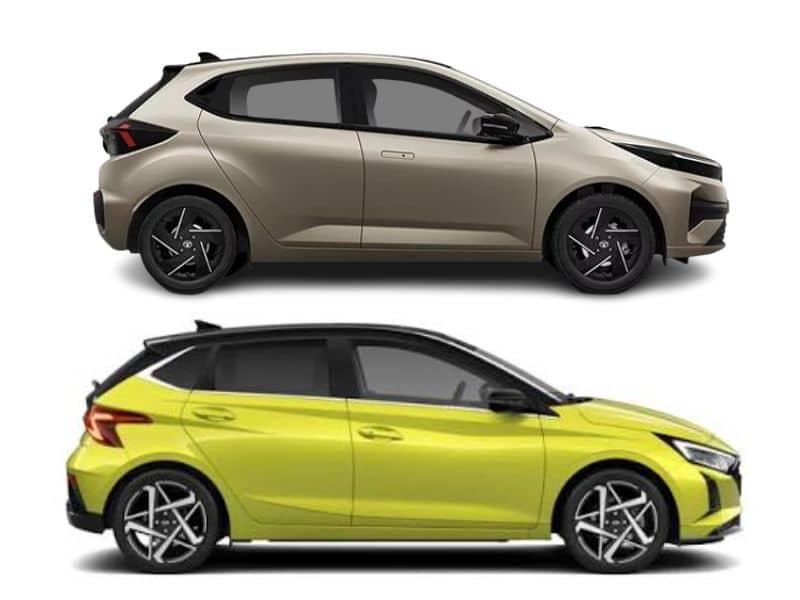
This is where the segment’s real weakness shows up. Tata Altroz fell 38.95% YoY to 2,426 units, down from 3,974 units in June 2025. Hyundai i20 dropped even harder, down 51.70% YoY and 61.51% MoM to just 1,828 units. Toyota Glanza, essentially a rebadged Baleno, was the one premium-leaning model that bucked the trend, up 19.54% YoY to 3,512 units.
Two different explanations are at play, and conflating them would be a mistake. Altroz’s decline looks structural: Tata’s own portfolio focus has shifted hard toward Punch, Nexon and the newly launched Sierra, all of which now do the heavy lifting for the brand’s growth. Altroz isn’t getting a facelift or aggressive marketing push right now, and it shows. Hyundai i20’s collapse has a more immediate cause.
Why the Numbers Look Different This Month
Two supply-side disruptions distorted June’s figures across the board, and any honest read of this month’s data has to account for them.
Maruti Suzuki advanced its scheduled bi-annual production shutdown from the originally planned June 27 to July 2 window to June 6 to June 11 instead. That one-week maintenance closure hit wholesale dispatches company-wide, which is part of why Maruti’s overall domestic sales fell 22.67% month-on-month even as most individual hatchback nameplates still posted solid YoY growth. The shutdown compressed dispatch timing, not underlying demand.
Hyundai’s disruption was more serious. A fire at one of its suppliers’ manufacturing facilities caused a production loss of roughly 13,900 units during June, according to the company’s own statement. Hyundai expects to recover the lost volume within the second quarter of FY26-27. That production hit is the most direct explanation for why i20 and, to a lesser extent, Grand i10 Nios saw such volatile monthly swings, i20 down 61.51% MoM, Grand i10 Nios up 66.61% MoM on a low May base.
Wholesale vs Retail: What These Numbers Actually Measure
Worth flagging clearly: the figures above are the manufacturers’ own reported domestic sales, essentially what left the factory for the domestic market, not FADA’s retail registration data measuring what customers actually took home from dealerships. When a company advances or delays a production shutdown, as Maruti did this month, wholesale dispatch numbers move independently of real consumer demand for a few weeks. A cleaner read on genuine buyer appetite for these models will only be possible once June’s FADA retail registration numbers are out and can be checked against these dispatch figures.