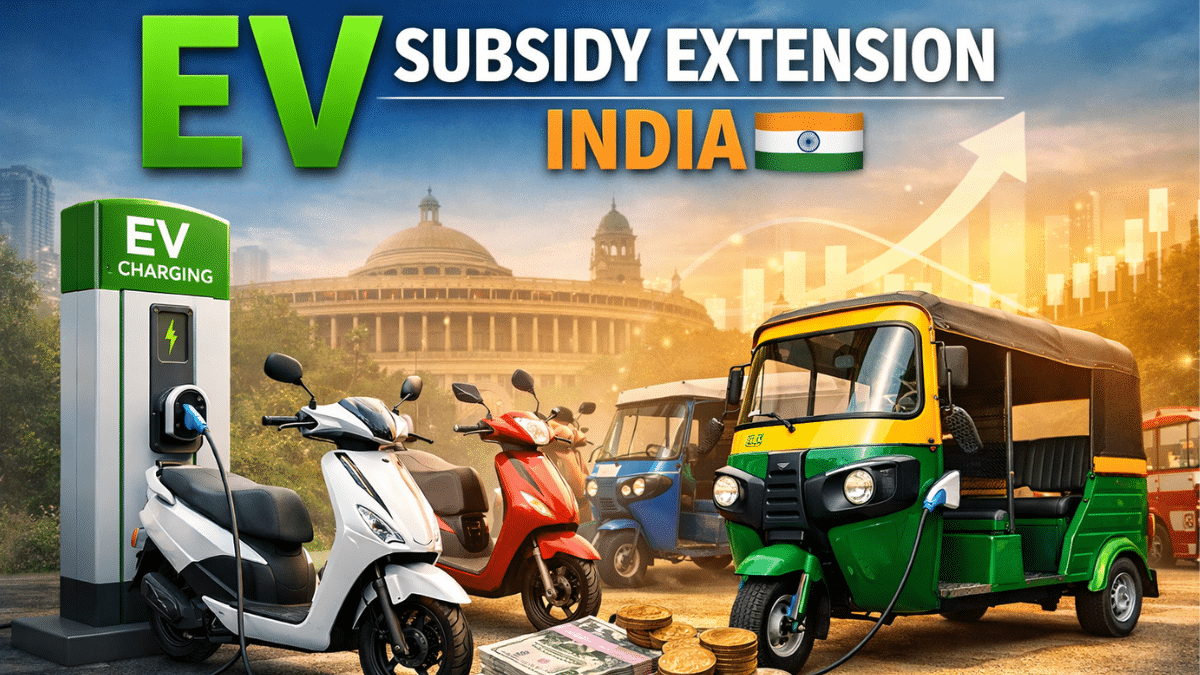

EV Subsidy Extension India is under active consideration as the government looks to continue financial support for electric two-wheelers and three-wheelers. These segments are critical to India’s EV ecosystem, and subsidies have played a major role in making electric mobility more accessible to everyday users.
With the current incentive timeline nearing its end, authorities are evaluating whether extending these benefits can help maintain the growth momentum in the market.
Government’s Proposal
The Ministry of Heavy Industries has sought approval to extend subsidies for electric two-wheelers and three-wheelers beyond the existing deadline of March 2026.
These incentives are part of ongoing efforts to accelerate EV adoption in the country, especially in segments that see high daily usage. The final decision will depend on approval from the Finance Ministry.
🚀 Join Our Tech Community!
Get the latest news, updates, and tech trends delivered straight to your phone. Never miss an update!
Why Extension is Being Considered
One of the key reasons behind the EV Subsidy Extension India proposal is the availability of unutilised funds. A portion of the allocated budget for these segments has not yet been fully used, prompting the government to consider extending the scheme.
Another important factor is that EV adoption in two- and three-wheelers, while growing, has not yet reached its full potential. Continued incentives can help bridge this gap and encourage more users to switch to electric vehicles.
Importance of Two- and Three-Wheelers
Electric two-wheelers and three-wheelers are the backbone of India’s EV market.
They are widely used for daily commuting, delivery services, and last-mile connectivity. Their affordability and practicality make them the most suitable categories for large-scale EV adoption.
Because these segments are highly price-sensitive, subsidies play a crucial role in influencing purchase decisions.
Impact on the Market
If the EV Subsidy Extension India proposal is approved, it could have a significant positive impact.
It would help keep electric vehicles affordable for a larger section of buyers.
It would support manufacturers by ensuring steady demand and production stability.
It would also accelerate the overall transition to electric mobility in India.
Industry View
The industry has been pushing for the continuation of subsidies, especially for two- and three-wheelers.
Manufacturers believe that withdrawing incentives too soon could slow down growth, particularly in cost-sensitive segments.
They argue that the market still needs policy support to achieve scale and become self-sustaining.
Challenges to Consider
While extending subsidies can boost adoption, it also raises concerns about long-term sustainability.
The government must balance financial support with budget constraints.
There is also a need to gradually reduce dependence on subsidies as the EV market matures.
Finding the right balance between growth and financial discipline will be important.