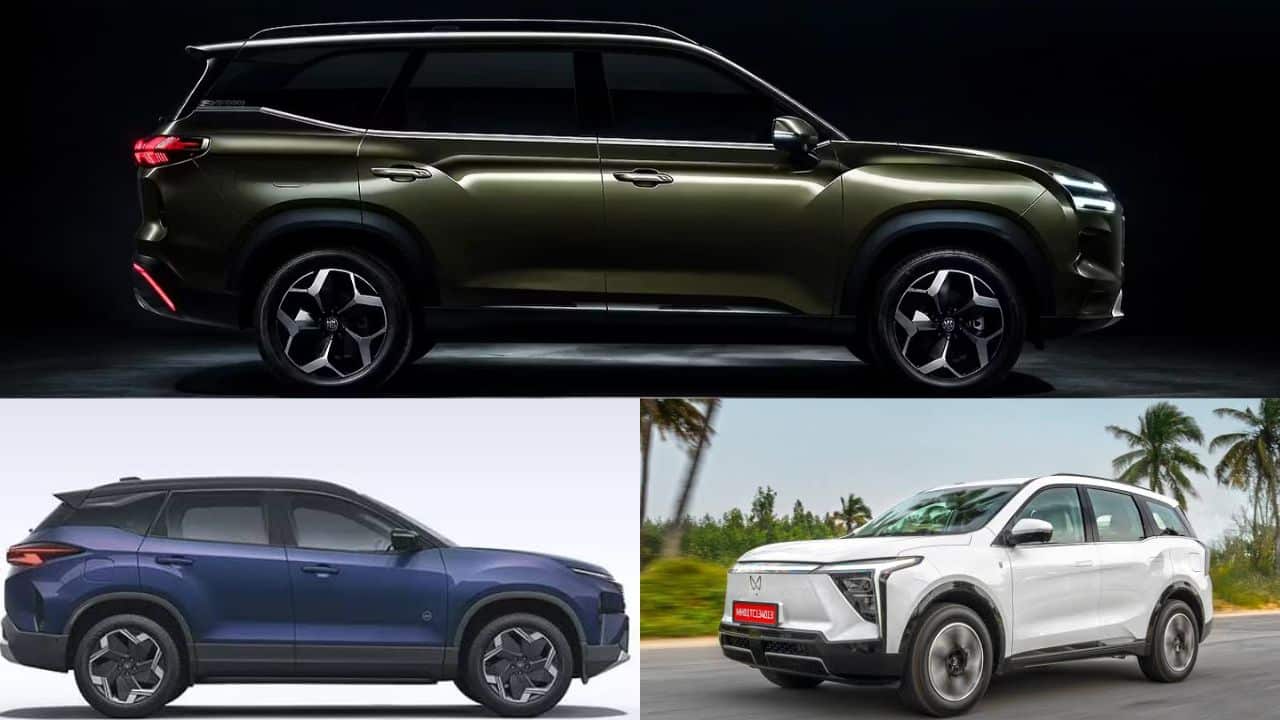

The premium electric SUV space in India is about to get more crowded. JSW MG Motor India launches the Hector Hawk on August 26, and it’s arriving with both a full EV and a plug-in hybrid option under one nameplate, a first for this price bracket in the country. That puts it on a direct collision course with two SUVs that have already built a following here: the Tata Harrier EV and the Mahindra XEV 9S.
Since the Hector Hawk hasn’t officially launched yet, most of its numbers below are still expected figures reported ahead of the reveal, not confirmed specifications. Treat this as a pre-launch positioning guide rather than a final verdict, and check back once MG’s own spec sheet lands.
Price comparison
| SUV | Ex-showroom price range |
|---|---|
| MG Hector Hawk (expected) | Roughly ₹18-25 lakh, with some estimates going as high as ₹30 lakh |
| Tata Harrier EV | ₹21.49 lakh to ₹30.23 lakh |
| Mahindra XEV 9S | ₹19.95 lakh to ₹30.90 lakh |
If the lower end of the Hector Hawk’s expected pricing holds up, MG could undercut both rivals at entry level, particularly if the PHEV variant is priced below the pure-EV trims. But given how wide the current estimate range is, this is the single biggest unknown until August 26.
Battery and range
MG Hector Hawk (expected): The EV version is expected to run a roughly 69.2 kWh battery pack with a claimed range of up to 530 km on the CLTC cycle. The PHEV pairs a 1.5-litre petrol engine with a 20.5 kWh battery, expected to deliver around 125 km of electric-only range and over 1,000 km combined. None of these figures are India-certified yet, and CLTC numbers typically run higher than what ARAI or real-world testing will show.
🚀 Join Our Tech Community!
Get the latest news, updates, and tech trends delivered straight to your phone. Never miss an update!
Tata Harrier EV: Offered with 65 kWh and 75 kWh battery packs, with ARAI-claimed range spanning 538 km to 627 km depending on variant and drivetrain. Real-world city range on the larger pack has been reported in the 410-505 km band by some reviewers.
Mahindra XEV 9S: The widest battery spread of the three, with 59 kWh, 70 kWh, and 79 kWh options, and a claimed range stretching from 521 km up to 679 km on the top-spec pack. Independent real-world testing has recorded around 510 km on the largest battery, close to 75% of the claimed figure.
The Harrier EV and XEV 9S both have ARAI-certified numbers backing their range claims. The Hector Hawk’s 530 km figure is a global CLTC number, so it isn’t directly comparable yet, and buyers should wait for the India-certified figure before treating it as equivalent to its rivals’ ARAI ratings.
Power and drivetrain
The Tata Harrier EV is the only one of the three currently offering all-wheel drive, badged Quad Wheel Drive, available on the top Empowered trim with a dual-motor setup producing around 390 bhp. Lower trims run rear-wheel drive only.
The Mahindra XEV 9S is rear-wheel drive across the range, with power varying by battery pack from 228 bhp up to 282 bhp on the top 79 kWh variant, all delivering 380 Nm of torque.
The Hector Hawk EV is expected to run a single front-mounted motor producing around 201-204 PS and 310 Nm, which would make it the least powerful of the three on paper, though MG’s PHEV option gives it a powertrain configuration neither rival currently offers.
Seating and practicality
All three are three-row SUVs aimed at families, but the approach differs. The Harrier EV and XEV 9S are both established models with published boot and cabin dimensions, the XEV 9S offering 500 litres of boot space with the third row folded, and the Harrier EV offering 502 litres of boot space plus a 67-litre front frunk.
The Hector Hawk is expected to seat seven in a 2+3+2 layout with a bench-style second row, and teaser images have confirmed a beige-and-black cabin theme, a two-spoke steering wheel, a large touchscreen and a panoramic sunroof. Final cabin dimensions and boot space haven’t been disclosed.
Safety
The Tata Harrier EV has been crash-tested by Bharat NCAP and carries a 5-star rating for both adult and child occupant protection. The Mahindra XEV 9S comes with a comprehensive ADAS suite from its Pack 3 variant onward, including forward collision warning, lane keep assist, rear cross-traffic alert and blind-spot detection. Neither the Hector Hawk’s crash-test status nor its full ADAS specification has been confirmed yet, since the vehicle hasn’t launched.
Where each SUV is expected to win
Based on what’s known so far, the Tata Harrier EV’s clearest edge is its all-wheel-drive option and confirmed 5-star safety rating, both of which matter to buyers cross-shopping this segment for genuine highway and light off-road use. The Mahindra XEV 9S leans on its wider battery choice and the longest claimed range in the group, along with a feature list built around its triple-screen cabin. The Hector Hawk’s potential advantage, if its expected pricing holds, is being the only one of the three offering a plug-in hybrid alongside a full EV, giving buyers a petrol-backed option the other two don’t have at all.