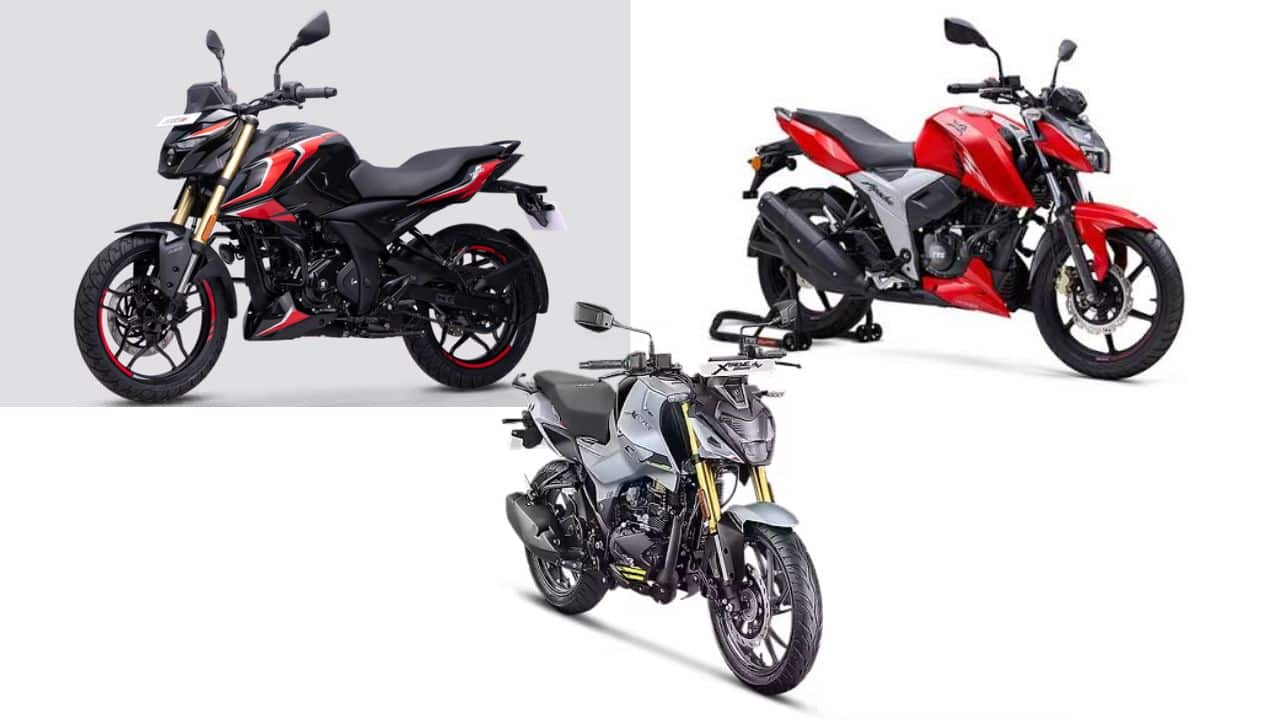

Bajaj just reshuffled the 160cc streetfighter segment with the Pulsar N160 S and N160 SS, and that means the two bikes that have owned this space for years, the TVS Apache RTR 160 4V and the Hero Xtreme 160R 4V, suddenly have a genuine fight on their hands. All three sit in roughly the same ₹1.19 lakh to ₹1.43 lakh ex-showroom bracket, all three run four-valve engines now, and all three are chasing the same buyer: someone who wants a proper streetfighter, not a commuter with a fairing bolted on.
Engine and Performance: Who Actually Pulls Hardest?
The Pulsar N160 S and SS get a brand-new 164.5cc, single-cylinder, oil-cooled, four-valve engine that makes 18.5 PS at 9,500 rpm and 14.4 Nm at 8,000 rpm, according to Bajaj’s own official specs. That’s a genuine jump over the outgoing 2-valve N160, and Bajaj is calling it the most powerful 160 in the segment. Both the S and SS get Ride-by-Wire, which Bajaj brands as Intelligent Throttle, so throttle response is electronically mapped rather than run off a cable.
The Apache RTR 160 4V, updated by TVS earlier this year, uses a 159.7cc oil-cooled four-valve motor that’s actually mode-dependent. In Sport mode you get 17.55 PS at 9,250 rpm and 14.73 Nm at 7,500 rpm. Switch to Urban or Rain and output drops to 15.64 PS and 14.14 Nm, which is a deliberate detuning for smoother low-speed response rather than a weakness. Top speed comes out to 114 kmph in Sport and 103 kmph in Urban and Rain.
The Hero Xtreme 160R 4V sits a step behind on paper, with a 163.2cc air-and-oil-cooled four-valve engine making around 16.9 PS at 8,500 rpm and 14.6 Nm at 6,500 rpm. What’s worth noting is where that torque peaks: at 6,500 rpm, well below the other two, which usually means it feels punchier low down in city traffic even if the top-end number is smaller.
🚀 Join Our Tech Community!
Get the latest news, updates, and tech trends delivered straight to your phone. Never miss an update!
So on outright numbers, the N160 S/SS leads, the Apache 4V is close behind in Sport mode and arguably the most flexible thanks to its three ride-mode outputs, and the Xtreme 160R 4V trades outright power for a torque curve built for stop-start riding.
Pricing: Where Each Bike Actually Lands
Ex-showroom Delhi pricing, based on the latest available listings:
| Motorcycle | Starting Price | Top Variant Price |
|---|---|---|
| Bajaj Pulsar N160 S | ₹1,33,511 | – |
| Bajaj Pulsar N160 SS | ₹1,42,585 | ₹1,42,585 |
| TVS Apache RTR 160 4V | ₹1,25,000 (approx., 2026 entry variant) | ₹1,39,000 (approx., top USD fork/TFT variant) |
| Hero Xtreme 160R 4V | ₹1,30,515 | ₹1,33,244 (Pro/USD fork variant) |
A few things jump out here. The Xtreme 160R 4V’s spread across its three variants (Standard, Connected, Pro) is the tightest of the three, so you’re not paying a huge premium to go from base to top-spec. The Apache RTR 160 4V has by far the widest variant spread of any bike in this segment, which means there’s a genuinely affordable entry point, but also that you need to check exactly which variant you’re comparing before drawing conclusions. The N160 range is the simplest to shop: just two trims, S and SS, with a clear ₹9,000-odd gap between them for the extra tech on the SS.
Remember that these are ex-showroom Delhi figures. On-road price will run higher once you add RTO registration, insurance, and state-specific road tax, and that gap varies meaningfully by state, so treat these as a starting reference rather than what you’ll actually pay at the dealership.
Features and Tech: This Is Where the N160 Pulls Ahead
This is genuinely where the Pulsar N160 SS separates itself from the pack. It gets a 5-inch TFT display with Google Maps mirroring, which Bajaj claims is a first for any sports motorcycle sold in India. Add to that four ride modes (Rain, Sport, Road, and Off-road), Responsive Traction Control, Crawl Tech for creeping through traffic without riding the clutch, a 37mm USD fork, a 300mm front disc, dual-channel ABS, and adjustable levers. The N160 S gets most of the mechanical upgrades but skips the TFT for an LCD and drops traction control.
The Apache RTR 160 4V isn’t far behind on the tech front. Its 2026 update brought a USD fork and hydroformed handlebar on the top variant, along with Lean Angle Mode, traction control, and race telemetry trickled down from the bigger RTR 200 4V. It runs three ride modes rather than four, and Glide Through Technology lets it crawl in traffic in first gear without touching the clutch, similar in spirit to Bajaj’s Crawl Tech. TVS SmartXonnect handles connectivity, with turn-by-turn navigation, call and SMS alerts, and voice assist.
The Xtreme 160R 4V is the most straightforward of the three. Full LED lighting across the board is a genuine segment highlight, and the Pro variant gets a 37mm inverted KYB fork, matching the other two on suspension hardware at the top end. But there’s no TFT display, no traction control, and no dedicated ride modes here, just a solid digital instrument cluster with the usual speed, RPM, gear position, and trip data.
If gadgetry and rider aids are what you’re shopping for, the N160 SS is the clear leader, with the updated Apache 4V close behind. The Xtreme 160R 4V is playing a different game: fewer electronics, but nothing that feels half-baked either.
Mileage and Everyday Usability
The Xtreme 160R 4V claims an ARAI figure of 46 kmpl, the best on paper of the three, helped by its air-oil-cooled engine and lighter overall build. The Apache RTR 160 4V comes in at an ARAI-claimed 41.4 kmpl, with real-world figures typically landing between 37 and 42 kmpl depending on how much time you spend in Sport mode. The Pulsar N160 S is ARAI-rated at 44 kmpl.
Kerb weight tells a similar story. The Xtreme 160R 4V is the lightest at around 139.5 to 144 kg depending on variant, the Apache RTR 160 4V comes in at 147 kg, and the Pulsar N160 S is the heaviest of the three at 151 kg, largely a result of the added electronics and the beefier USD fork upfront. That extra weight on the N160 isn’t necessarily a bad thing on the highway, where it should feel more planted, but it’s worth knowing if you’re mostly navigating tight city lanes.
Ride Modes and Traffic Manners
All three bikes now offer some form of low-speed crawl assist, Bajaj’s Crawl Tech, TVS’s Glide Through Technology, and while Hero hasn’t badged an equivalent feature on the Xtreme 160R 4V, its torque-heavy low-end delivery does a similar job without needing an electronic assist. If you spend most of your riding life in bumper-to-bumper city traffic, this is a genuinely useful feature to prioritize, not just a spec-sheet checkbox.
For highway stints, the N160 SS’s traction control and the Apache 4V’s lean angle mode give both bikes a real safety margin the Xtreme 160R 4V simply doesn’t offer. That matters more if you’re planning regular out-of-city rides than if this is purely a daily commuter.
Buy the Pulsar N160 SS if you want the most tech-loaded, most powerful bike here and don’t mind paying the highest asking price for it. The TFT with Google Maps, traction control, and Crawl Tech make it feel genuinely a class above on paper, though it’s also the heaviest of the three.
Buy the TVS Apache RTR 160 4V if you want flexibility. The three ride modes mean you can dial down power for a relaxed daily commute and dial it back up for weekend rides, and the sheer number of variants means there’s likely a configuration that fits your exact budget, from the sub-₹1.3 lakh entry trims to the fully-loaded USD fork version.
Buy the Hero Xtreme 160R 4V if mileage, low-end torque for traffic, and a lighter, more manageable everyday bike matter more to you than a long features list. It gives up the TFT display, traction control, and ride modes, but it’s also the easiest of the three to live with day to day and claims the best fuel efficiency on paper.
None of these three is a bad choice at this price point. The honest difference comes down to whether you’re buying for the spec sheet or for the daily grind, and each bike here is built with a slightly different answer to that question.