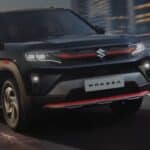

For the first time, the Brezza gives buyers a genuine three-way engine choice: a new turbo-petrol, the familiar naturally aspirated 1.5-litre, and CNG with a redesigned tank. That’s more flexibility than the outgoing car offered, but it also means the wrong pick is easier to make if you’re going purely on power figures or purely on running cost. Here’s how to actually decide.
The Three Options at a Glance
| Engine | Power/Torque | Transmission | ARAI Mileage | Best For |
|---|---|---|---|---|
| 1.0L Boosterjet Turbo | 110 PS / 170 Nm | 6-speed MT only | 19.96-20.47 kmpl | Mixed city-highway driving, frequent overtaking |
| 1.5L K15C Petrol | 103 PS / 139 Nm | 6-speed MT or AT | Up to 21.09 kmpl (MT), 20.17 kmpl (AT) | Predictable, low-maintenance city driving |
| 1.5L K15C CNG | Reduced output on CNG | 6-speed MT only | 26.90 km/kg | High monthly running, fleet or ride-hailing use |
Note that these are ARAI-certified test figures, not real-world numbers. Expect city driving with the AC running to return noticeably lower mileage than these figures suggest, particularly on the turbo engine.
The 1.0L Boosterjet Turbo-Petrol
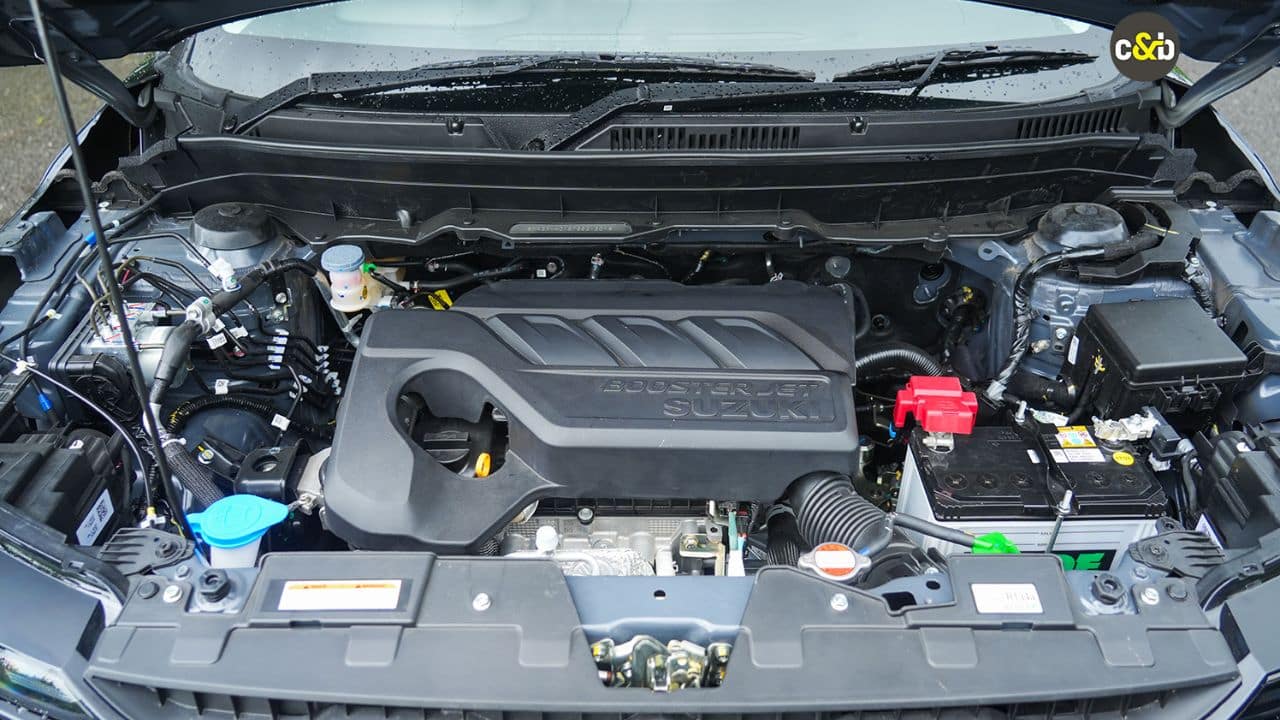
The Boosterjet is genuinely new to the Brezza, borrowed from the Fronx and tuned to make 110 PS and 170 Nm. On paper, its ARAI mileage is actually slightly lower than the naturally aspirated engine’s best manual figure, which surprises buyers who assume a smaller-displacement turbo automatically means better efficiency. It doesn’t, not on this comparison.
What the Boosterjet actually delivers is usable torque lower in the rev range. That matters more in daily driving than the spec sheet suggests: overtaking a truck on a two-lane highway, pulling away cleanly from a flyover incline in bumper-to-bumper traffic, or carrying a full car of five adults without the engine feeling strained. The naturally aspirated 1.5-litre has always been adequate rather than eager, and the Boosterjet is the direct answer to that long-standing complaint.
🚀 Join Our Tech Community!
Get the latest news, updates, and tech trends delivered straight to your phone. Never miss an update!
There’s a real limitation worth flagging before you commit: the Boosterjet is manual-only, at least for now. If you specifically want an automatic gearbox, this engine isn’t available to you regardless of trim or budget.
The Boosterjet is also where most of the newer safety tech lives. Cruise control, front parking sensors, blind-spot warning, rear cross-traffic alert, and tyre-pressure monitoring are all exclusive to Boosterjet variants from ZXi upward, none of it is available on the naturally aspirated ZXi at the same trim level. If you’re choosing the turbo purely for the engine character, know that you’re also unlocking a genuinely longer safety features list in the process.
The 1.5L K15C Naturally Aspirated Petrol
This is the known quantity. The K15C has been in the Brezza since the current generation launched in 2022, and it carries a real-world ownership track record that a brand-new engine simply can’t match yet. It makes 103 PS and 139 Nm, and it’s the only engine in the lineup offered with both a manual and a 6-speed torque converter automatic.
If your driving is mostly flat city commuting with the occasional highway trip, the naturally aspirated engine was never underpowered enough to be a genuine dealbreaker for that use case. It’s smoother in its power delivery than the turbo, doesn’t demand the same attentiveness to keep it in its power band, and, because it’s a proven unit, tends to come with more predictable long-term maintenance costs, since technicians across India’s service network are already deeply familiar with it.
The naturally aspirated automatic specifically deserves a mention here: it’s the only automatic option in the entire Brezza range apart from… itself. Neither the Boosterjet nor CNG offer an automatic gearbox at all, so if a torque converter automatic is non-negotiable for you, the naturally aspirated 1.5-litre is your only path to one.
The 1.5L CNG
CNG buyers get the same 1.5-litre engine, running on reduced power output in CNG mode, paired exclusively with the 6-speed manual gearbox. The real story here isn’t the engine, it’s what’s changed around it. The 2026 Brezza moves to an underbody-mounted CNG tank borrowed from the Victoris, replacing the boot-mounted cylinder that used to visibly eat into luggage space on the outgoing car. That’s a genuine practicality fix, not a cosmetic change.
CNG makes the strongest financial case for anyone doing high monthly running, fleet operators, ride-hailing drivers, or anyone regularly covering 1,500-2,000 km or more a month. At an ARAI-rated 26.90 km/kg, the running-cost gap over petrol compounds fast at that kind of usage, and it’s usually the deciding factor over any other consideration for these buyers.
The trade-offs are worth being upfront about. Power output drops on CNG mode compared to running on petrol, so acceleration and highway overtaking feel noticeably less eager than either petrol option. CNG is also locked to the manual gearbox and unavailable on the ZXi+ trim entirely, if you want the top-spec Brezza, CNG simply isn’t on the table.
Matching the Engine to Your Driving Pattern
Mostly city driving, occasional highway trips, budget-conscious: The naturally aspirated 1.5-litre petrol is the sensible default. It’s proven, it’s available with an automatic if you want one, and it was never genuinely underpowered for this use case.
Regular highway driving, frequent overtaking, carrying a full car often: The Boosterjet turbo is the better fit. The extra low-end torque genuinely changes how relaxed the car feels at speed, and you gain access to more safety tech in the process, provided you’re comfortable with a manual gearbox.
High monthly running, fleet use, or ride-hailing: CNG is the clear financial choice. The running-cost savings at 1,500+ km a month outweigh the reduced power output for buyers whose priority is minimizing per-kilometre cost, and the new underbody tank means you’re not sacrificing boot space to get there.
Want an automatic gearbox, no exceptions: Your only option in this lineup is the naturally aspirated 1.5-litre automatic. Neither the turbo nor CNG offer an automatic at all.
What Nobody Tells You About This Comparison
The Boosterjet’s ARAI mileage being lower than the naturally aspirated manual’s best figure is the detail most buyers miss, and it’s worth repeating because it cuts against the usual assumption that smaller-displacement turbo engines are always more efficient. They’re not, at least not on this spec sheet. If mileage alone is your deciding factor, don’t assume the turbo wins by default, run the actual numbers for your use case.
The other detail worth flagging: CNG and the Boosterjet turbo are mutually exclusive by design, not by trim restriction. There is no combination anywhere in the Brezza 2026 lineup that gives you turbo power and CNG running costs together. You have to pick one priority or the other.
Choose the 1.5-litre naturally aspirated petrol if you want the lowest-risk, most predictable ownership experience, or if an automatic gearbox is a requirement rather than a preference. Choose the Boosterjet turbo-petrol if your driving genuinely includes regular highway stretches or a consistently full car, and you’re fine with a manual, the extra torque and expanded safety kit justify the trade-off. Choose CNG if your monthly running comfortably crosses 1,500-2,000 km, where the fuel savings become the dominant factor over any driving-feel consideration, and you’ll benefit from the new underbody tank’s improved boot space over the outgoing model’s setup.
Frequently Asked Questions
Is the Brezza turbo-petrol more fuel-efficient than the 1.5L petrol?
No. The Boosterjet turbo’s ARAI mileage of 19.96-20.47 kmpl is actually slightly lower than the naturally aspirated 1.5-litre manual’s best figure of up to 21.09 kmpl. The turbo’s advantage is low-end torque, not fuel efficiency.
Can I get the Brezza turbo-petrol with an automatic gearbox?
No. The Boosterjet turbo-petrol is available exclusively with a 6-speed manual transmission. The only automatic option in the Brezza 2026 lineup is on the 1.5-litre naturally aspirated petrol.
Does CNG reduce the Brezza’s power output?
Yes. The 1.5-litre engine produces reduced power and torque when running on CNG compared to petrol mode, which is a normal characteristic of factory-fitted CNG systems, not specific to the Brezza.
Is CNG worth it on the Brezza for a typical city commuter?
CNG makes the strongest financial sense for buyers covering 1,500-2,000 km or more per month. For lower monthly running, the fuel savings may not offset the reduced power output and manual-only limitation for every buyer.