
Electric cars attract attention, curiosity and fear.
Many Indian buyers hesitate not because of price or charging, but due to perceived risks around safety, breakdowns, batteries, and long-term reliability.
This guide addresses the most common EV fears in India, separating genuine concerns from myths, so buyers can make informed decisions without anxiety.
Why EV Fear Exists in India
Electric cars are still relatively new in the Indian mass market. Most buyers have decades of experience with petrol and diesel vehicles, while EV ownership is unfamiliar.
Fear usually comes from:
🚀 Join Our Tech Community!
Get the latest news, updates, and tech trends delivered straight to your phone. Never miss an update!
- Limited real-world exposure
- Viral social media incidents
- Misinformation about batteries
- Confusion between early EVs and modern models
Understanding the facts behind these fears is essential.
Fear 1: “Electric Cars Catch Fire Easily”
This is the most widespread concern.
Reality:
Electric car fires are rare and statistically less frequent than petrol car fires per vehicle sold.
Modern EVs sold in India:
- Use sealed lithium-ion battery packs
- Have multiple thermal sensors
- Automatically disconnect power during faults
- Are tested under Indian safety standards
Manufacturers like Tata Motors and Mahindra have redesigned battery placement, cooling systems, and software protection after early learnings.
Most reported EV fire incidents involved:
- Aftermarket electrical modifications
- Flood-damaged vehicles
- Two-wheelers with cost-cutting battery designs
Passenger electric cars today are significantly safer than early perceptions suggest.
Fear 2: “What If the Battery Fails Suddenly?”
EV batteries do not fail like engines.
How battery degradation actually works:
- Capacity reduces gradually over years
- Range drops slowly, not overnight
- The car remains drivable even with degradation
Most EVs in India come with:
- 8-year / 1,60,000 km battery warranty
- Performance guarantees within safe limits
In practical terms, a battery losing 10–15% capacity over several years does not make the car unusable for daily driving.
Fear 3: “Breakdowns Will Leave Me Stranded”
EVs have fewer mechanical failure points than petrol cars.
No:
- Clutch failure
- Gearbox breakdown
- Engine overheating
- Fuel pump issues
Most EV issues are:
- Software-related
- Sensor warnings
- Charging errors
These are often resolved via:
- Software updates
- Remote diagnostics
- Simple resets at service centres
Modern EVs actively monitor system health, often alerting drivers before a serious issue develops.
Fear 4: “EVs Are Unsafe in Floods or Rain”
This fear is common during Indian monsoons.
Reality:
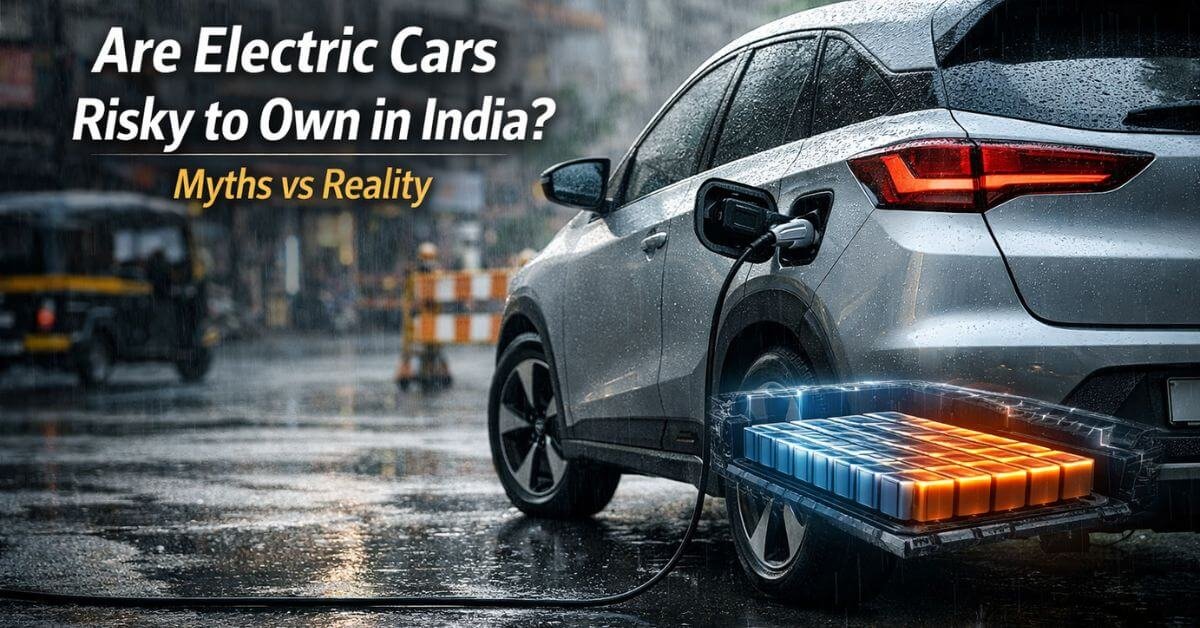
- EV battery packs are sealed and waterproof
- High-voltage systems are isolated from the cabin
- Automatic power cut-off occurs during water ingress detection
Electric cars undergo:
- Water wading tests
- Short-circuit protection validation
- Electrical insulation testing
Driving any car petrol or electric through deep floodwater is unsafe. EVs are not uniquely vulnerable in this scenario.
Fear 5: “Repair Costs Will Be Extremely High”
This fear comes from battery replacement assumptions.
In practice:
- Regular servicing is cheaper than petrol cars
- EV brake wear is lower due to regenerative braking
- No oil changes or engine part replacements
Battery replacement is:
- Rare within warranty
- Gradual degradation rather than sudden failure
- Covered for manufacturing defects
For most owners, EV repair costs over 5–7 years remain lower than petrol equivalents.
Fear 6: “EV Technology Is Too New to Trust”
While EVs feel new in India, electric drivetrains are not experimental.
Globally:
- EVs have crossed millions of vehicles on road
- Battery chemistry has matured over a decade
- Software-driven reliability has improved consistency
Indian-market EVs now use:
- Local climate-tested batteries
- Improved thermal management
- Conservative performance tuning for longevity
This generation of EVs is significantly more reliable than first-generation models.
Fear 7: “What If the Manufacturer Stops Supporting the Car?”
This concern is valid for any vehicle type.
However:
- EV platforms are long-term investments for manufacturers
- Battery warranties are legally binding
- Spare parts availability is improving rapidly
Established players like Hyundai Motor India and MG Motor India offer structured EV service ecosystems rather than experimental launches.
Real Risks EV Buyers Should Acknowledge
Not all fears are myths. Some risks deserve awareness:
- Public charging reliability varies by city
- Range planning is important for highway travel
- Charging speed depends on infrastructure quality
- Software dependence means occasional updates are needed
These are usage adjustments, not deal-breakers.
Who Should Be More Cautious Before Buying an EV
EV ownership may feel risky if:
- You lack home charging access
- Usage is primarily long-distance highway driving
- You change cars every 2–3 years
- You live in regions with limited service coverage
For city-focused users, these risks reduce significantly.
The Bottom Line
Electric cars in India are not risky by default.
Most fears come from early-stage perceptions, isolated incidents, or misunderstanding how EV technology works.
For informed buyers, modern EVs offer:
- Strong safety systems
- Predictable ownership costs
- Lower mechanical failure risk
- Growing service and support networks
Risk exists but it is manageable, understood, and often overstated.