
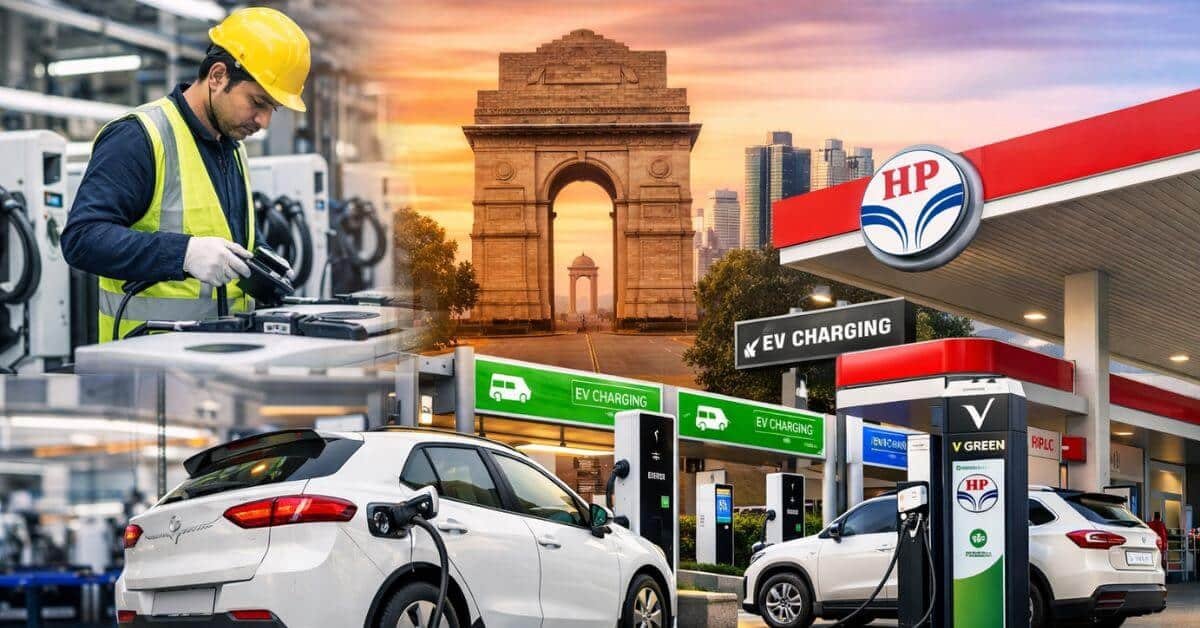

India’s electric mobility transition received a fresh boost as new investments and partnerships in EV charging infrastructure gained momentum, highlighting the government and private sector’s push to address one of the biggest barriers to electric vehicle adoption charging availability.
Major Manufacturing Investment Near Noida
The Yamuna Expressway Industrial Development Authority has moved to allot a 20,000 square metre land parcel near Noida for an electric vehicle charging equipment project. The proposed facility is expected to focus on manufacturing EV chargers and related power solutions, strengthening domestic production and reducing reliance on imports.
Industry estimates indicate the investment could run into hundreds of crores of rupees, with the project also expected to create local employment and support the growing EV ecosystem around the upcoming Noida International Airport region.
Officials see this as part of a broader strategy to make northern India a hub for EV hardware manufacturing, aligning with India’s long-term clean mobility goals.
🚀 Join Our Tech Community!
Get the latest news, updates, and tech trends delivered straight to your phone. Never miss an update!
Oil PSU Network Enters EV Charging Expansion
In a parallel development, EV charging expansion is also being driven by collaborations between automakers and fuel retailers. HPCL has partnered with V-GREEN, the charging infrastructure arm of VinFast, to deploy EV chargers at fuel stations across India.
The move leverages HPCL’s nationwide fuel station footprint, allowing EV charging points to be added quickly in high-traffic urban and highway locations. Such partnerships are increasingly viewed as a practical way to scale public charging without waiting for standalone infrastructure to be built from scratch.
Startups Attract Capital as Charging Demand Grows
Alongside large projects and PSUs, Indian EV charging startups are also seeing renewed investor interest. Companies like Kazam have reported strong revenue growth and expansion plans, reflecting rising demand from fleet operators, housing societies, and commercial users.
The participation of global investors such as the International Finance Corporation further signals confidence in India’s long-term EV charging potential.
Infrastructure Growth Still Uneven
While urban charging infrastructure is expanding rapidly, industry players continue to flag challenges in semi-urban and rural deployment, where lower utilisation rates make investments harder to justify. Experts say targeted incentives and state-level support will be critical to ensure charging access keeps pace with EV adoption beyond major cities.
India’s EV market is entering a phase where charging availability could define buyer confidence. Fresh investments in manufacturing, public charging rollouts, and startup expansion suggest the ecosystem is maturing, but consistent infrastructure growth will remain key to sustaining EV sales momentum.
As EV adoption accelerates in 2025 and beyond, charging infrastructure investments are increasingly becoming as important as new vehicle launches, shaping how quickly electric mobility becomes mainstream in India.