
Hybrid cars have become increasingly popular in recent years as more drivers look for vehicles that offer better fuel efficiency and lower emissions. With rising fuel prices and growing environmental awareness, many car buyers are now considering hybrid vehicles as a practical alternative to traditional petrol or diesel cars.
Despite their growing popularity, many people still wonder how hybrid cars actually work. The technology may sound complex, but the basic idea is simple. A hybrid vehicle combines a petrol engine and an electric motor to power the car, allowing it to use fuel more efficiently while reducing environmental impact.
What Is a Hybrid Car?
A hybrid car is a vehicle that uses two different power sources to move the car. Typically, these power sources include a petrol engine and an electric motor that work together to provide power to the wheels.
Unlike fully electric vehicles that rely only on battery power, hybrid vehicles can switch between the petrol engine and electric motor depending on the driving conditions. This intelligent combination helps improve fuel economy, reduce carbon emissions, and deliver smoother performance.
🚀 Join Our Tech Community!
Get the latest news, updates, and tech trends delivered straight to your phone. Never miss an update!
Most modern hybrid cars are designed to automatically manage how and when each power source is used. This means the driver does not need to manually switch between the petrol engine and electric motor. The system constantly monitors speed, acceleration, and battery levels to determine the most efficient way to power the vehicle.
Key Components of a Hybrid Vehicle
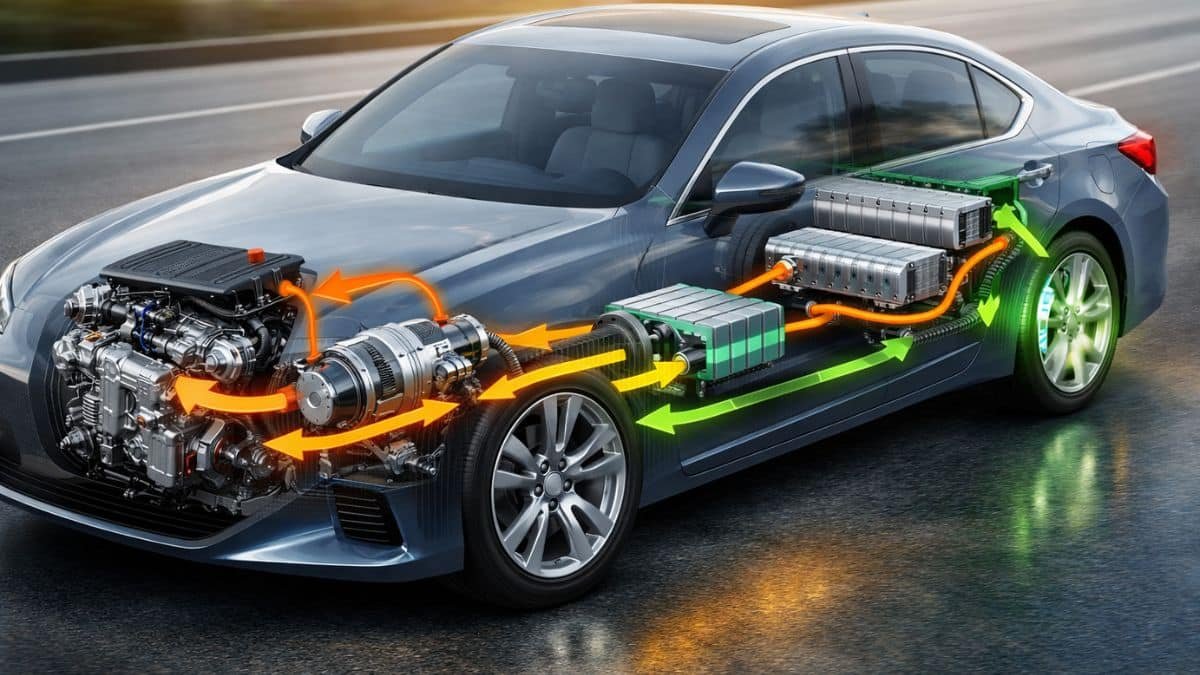
Understanding the main components of a hybrid vehicle helps explain how the entire system works together. Hybrid technology relies on several important parts that allow the vehicle to operate efficiently.
The petrol engine is similar to the engine used in a conventional car. It provides power during higher speeds, strong acceleration, or when the battery charge is low. The engine ensures the vehicle can travel long distances without needing external charging.
The electric motor works alongside the petrol engine and provides additional power when required. During low-speed driving, such as city traffic, the electric motor can power the car independently, helping reduce fuel consumption.
Another crucial component is the hybrid battery pack, which stores electricity used by the electric motor. This battery is larger and more powerful than a regular car battery. Unlike fully electric vehicles, most hybrid cars use a self-charging hybrid battery system that charges automatically while driving.
Hybrid vehicles also feature a power control unit that manages the flow of energy between the engine, motor, and battery. This system ensures that power is delivered efficiently and smoothly.
Regenerative Braking: How Hybrid Cars Recharge
One of the most important technologies used in hybrid cars is regenerative braking. This system helps recharge the battery while the car is slowing down. In a traditional car, braking converts kinetic energy into heat, which is lost. However, in a hybrid vehicle, regenerative braking captures some of that energy and converts it into electricity.
When the driver presses the brake pedal or lifts their foot off the accelerator, the electric motor works like a generator. It captures the vehicle’s kinetic energy and sends it back to the battery pack. This process helps keep the battery charged without requiring external charging. Regenerative braking is especially useful in city driving conditions, where frequent stopping and slowing down allow the system to recover more energy.
How Hybrid Cars Operate in Different Driving Conditions
Hybrid vehicles are designed to automatically switch between different power modes depending on driving conditions. This flexibility allows them to deliver both efficiency and performance. At low speeds, such as when driving in traffic or parking, the car often runs entirely on the electric motor. This reduces fuel usage and makes the vehicle very quiet.
During normal driving conditions, both the petrol engine and electric motor may work together. This combination provides smooth acceleration and improved fuel economy. When driving at higher speeds, the petrol engine usually becomes the primary power source. The electric motor may still assist the engine when additional power is required.
During braking or deceleration, regenerative braking captures energy and sends it back to the battery, helping recharge the system. This continuous switching between power sources allows hybrid cars to optimize fuel usage and maintain efficient performance.
Different Types of Hybrid Cars
There are several types of hybrid vehicles available today, each using slightly different technology.
Mild hybrid systems provide limited assistance to the petrol engine. The electric motor supports the engine during acceleration but cannot power the car on its own. Full hybrid cars, also known as self-charging hybrids, can operate using only the electric motor for short distances. These vehicles automatically switch between petrol and electric power.
Plug-in hybrid vehicles (PHEVs) have larger batteries that can be charged using an external power source. These vehicles can travel longer distances using electric power alone before the petrol engine is required. Each type of hybrid system offers different levels of efficiency, electric driving capability, and fuel savings.
Benefits of Hybrid Cars for Everyday Drivers
Hybrid vehicles provide several advantages for drivers looking for a balance between performance and efficiency.
One of the biggest benefits is improved fuel economy. Because the electric motor assists the petrol engine, hybrid cars typically consume less fuel compared to conventional vehicles. Another important advantage is lower emissions. By using electric power during certain driving conditions, hybrid vehicles produce fewer greenhouse gases and contribute to cleaner air.
Hybrid cars are also known for offering smooth and quiet driving experiences. Electric motors operate silently, which makes city driving more comfortable and relaxing. Additionally, hybrid vehicles often have lower long-term running costs, since they require less fuel and experience reduced engine strain.
Are Hybrid Cars Suitable for Indian Driving Conditions?
Hybrid vehicles are particularly well suited for urban traffic conditions, which involve frequent braking, slow driving speeds, and stop-and-go traffic.
These conditions allow hybrid systems to use the electric motor more often and recover energy through regenerative braking. As a result, many hybrid cars can deliver excellent mileage in city environments. For drivers who commute daily in heavy traffic or drive mostly within cities, hybrid vehicles can offer a practical and efficient solution.
The Future of Hybrid Technology
Hybrid technology is expected to play an important role in the transition toward cleaner mobility. While electric vehicles are becoming more common, hybrid cars continue to offer a practical solution for regions where charging infrastructure is still developing.
Automakers are investing heavily in advanced hybrid powertrains, energy management systems, and battery technology to further improve fuel efficiency and reduce emissions. For many buyers, hybrid cars represent a bridge between traditional petrol vehicles and fully electric mobility, making them an appealing option in today’s evolving automotive market.