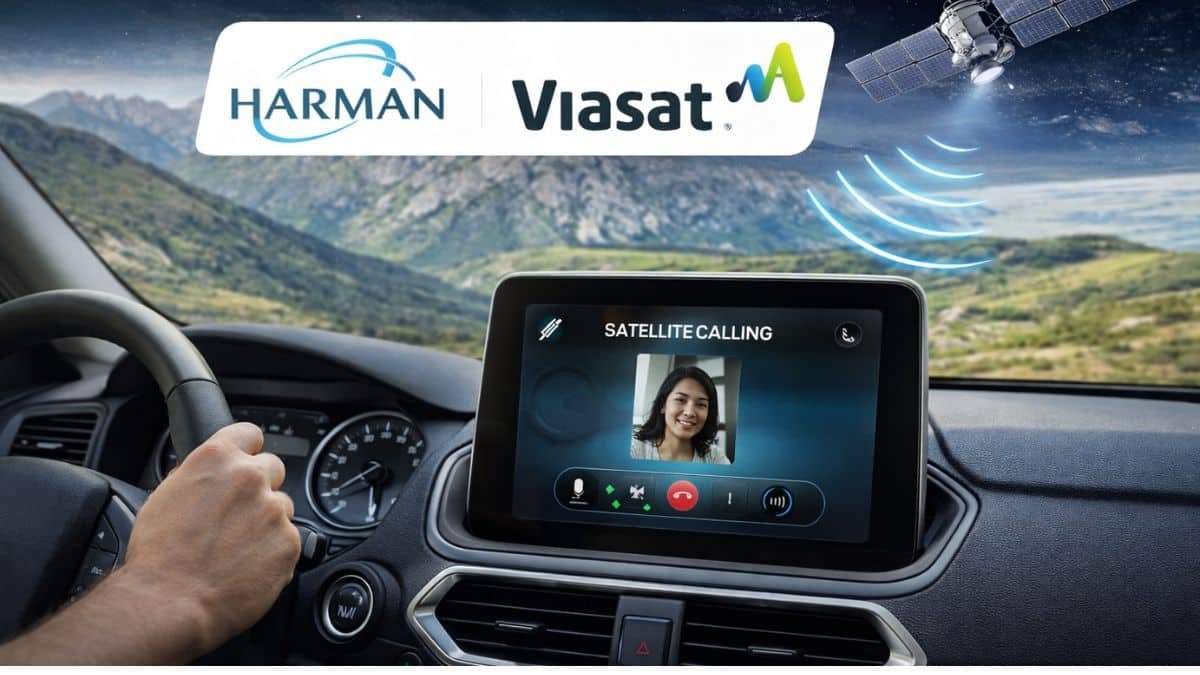

HARMAN International has announced a partnership with Viasat Inc. to enable satellite-based voice calling directly from vehicles. The collaboration introduces in-cabin satellite communication capability designed to work when traditional mobile networks are unavailable.
The system integrates HARMAN’s telematics control unit with Viasat’s mobile satellite services network. It supports existing 4G and 5G connectivity while adding satellite-based backup through non-terrestrial network (NTN) technology. When cellular coverage drops, the system can automatically switch to satellite connectivity to maintain essential voice communication.
This development is significant for markets like India, where large rural and highway stretches still experience inconsistent mobile network coverage. Satellite-enabled voice calling can provide an additional safety layer, especially for drivers travelling through remote terrain, hilly regions, or border areas.
The primary focus of the solution is safety-critical communication. Initial capabilities are centred on voice calls and emergency support functions rather than high-speed data transmission. The companies have clarified that satellite connectivity is meant to complement existing mobile networks, not replace them. Vehicles will continue using standard cellular networks wherever available, switching to satellite only when necessary.
🚀 Join Our Tech Community!
Get the latest news, updates, and tech trends delivered straight to your phone. Never miss an update!
The collaboration was showcased at an international technology event earlier this year, highlighting the growing integration of satellite services into automotive platforms. As vehicles become increasingly connected and software-driven, resilient communication systems are emerging as a priority for manufacturers.
From an industry standpoint, satellite-backed telematics could enhance features such as emergency calling, roadside assistance, and remote diagnostics. It may also support fleet operators in maintaining communication across long-distance transport routes where signal reliability remains a concern.
Automakers globally have been exploring satellite integration as part of next-generation connected car systems. The HARMAN–Viasat partnership positions both companies within this evolving space, offering a solution that can be embedded directly into vehicle hardware rather than relying solely on smartphones.
While specific vehicle models or launch timelines have not been announced, the collaboration indicates that satellite-enabled voice communication could gradually become part of premium and high-connectivity vehicle offerings.
As connected vehicle ecosystems expand, redundancy in communication networks is becoming increasingly important. Satellite voice integration represents a step toward improving communication resilience, particularly in geographies where network coverage gaps remain a challenge.
The move reflects broader automotive technology trends focused on safety, reliability, and uninterrupted connectivity in diverse driving environments.