

Why EV Battery Replacement Is a Major Buyer Concern
When buyers consider electric vehicles in India, the biggest long-term fear is battery replacement cost. Unlike petrol cars where engine repair is predictable, EV battery packs are expensive and technologically complex. Most warranties cover 8 years or 1.6 lakh km, but what happens after that period worries many potential buyers.
Battery degradation, charging habits, climate exposure, and usage patterns all affect long-term performance. However, actual battery failure within eight years is still uncommon in modern lithium-ion battery systems. The fear is often higher than the real-world risk.
How Much Does EV Battery Replacement Actually Cost?
Battery replacement cost in India depends heavily on vehicle segment and battery capacity. Entry-level EVs with 20–30 kWh packs may cost between ₹4–6 lakh for full replacement. Mid-size EVs with 35–45 kWh packs can range from ₹7–10 lakh, while premium EV battery packs may exceed ₹12 lakh.
It is important to understand that full pack replacement is rare. In many cases, manufacturers replace defective modules instead of the entire battery pack, which significantly reduces the expense. Battery management systems also protect cells from severe damage over time.
Factors that influence replacement pricing include:
- Battery chemistry and kWh capacity
- Import dependency and localisation level
These numbers sound high, but buyers must compare them with potential engine rebuild or gearbox replacement costs in conventional vehicles.
Degradation vs Complete Failure
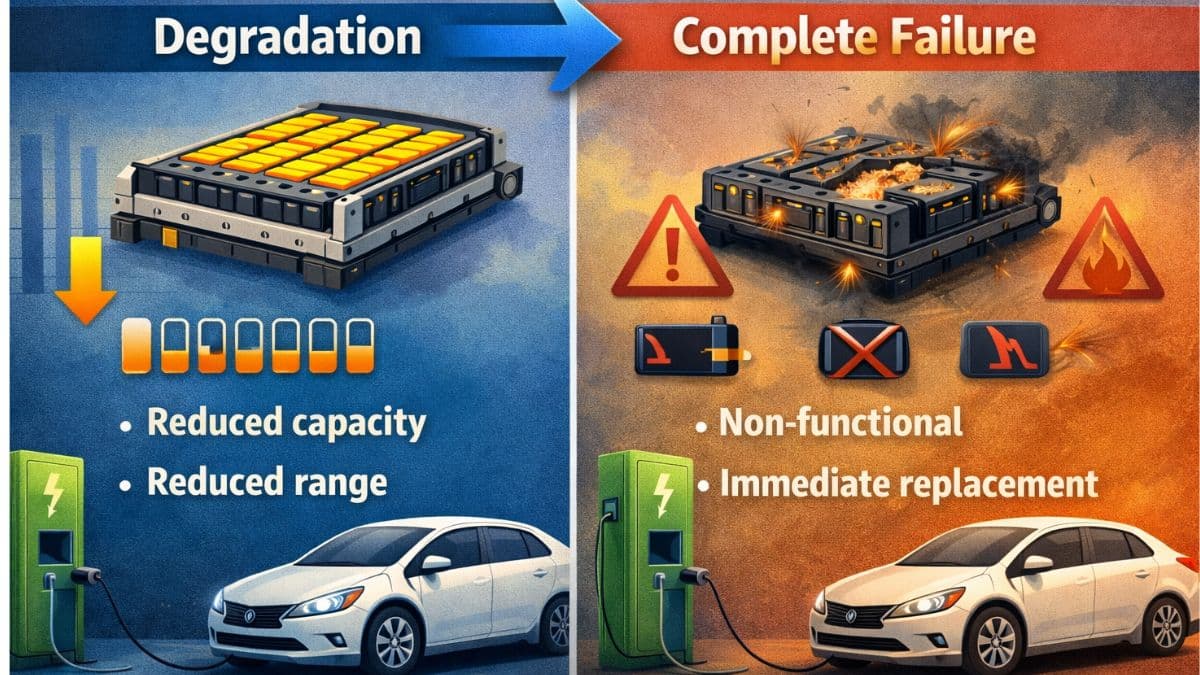
Battery degradation does not mean the car becomes unusable. Most EVs retain 70–80% battery health after 8 years under normal conditions. That still provides usable driving range for city commutes.
Heat management plays a crucial role in India’s climate. Vehicles with liquid cooling systems tend to preserve battery health better than passive air-cooled systems. Regular software updates also improve battery optimisation over time.
Understanding long-term ownership math is more important than reacting to fear-based assumptions.
Comparing Long-Term Cost With Petrol Cars
If a petrol SUV runs for eight years, owners may face clutch replacements, turbo issues, fuel injector cleaning, or automatic gearbox servicing. When comparing EV battery replacement with traditional transmission maintenance like CVT vs AMT driving, the cost difference over eight years becomes less dramatic than it initially appears.
Insurance premiums for EV batteries are now structured differently. Some policies allow battery cover add-ons, which protect against unexpected damage. This reduces the financial shock factor associated with replacement concerns.
Is Battery Replacement a Real Risk in 2026?
The Indian EV ecosystem is evolving rapidly. Local battery manufacturing is increasing, and cell prices globally are gradually declining. As localisation improves, replacement cost is expected to reduce further over the next few years.
For apartment residents, long-term EV ownership decisions should also factor in charging feasibility. Buyers already evaluating home EV charging installation costs should consider total lifecycle expense rather than focusing on battery replacement alone.
Most EV buyers upgrading within 6–7 years may never actually face full battery replacement. Resale markets are also beginning to factor battery health certification, which protects value retention.
Hidden Cost vs Perceived Risk
Battery replacement is often discussed as an inevitable expense. In reality, it is a low-probability event within eight years for properly maintained vehicles. Smart charging habits, avoiding constant 0–100% cycles, and not leaving vehicles at extreme temperatures for long periods significantly improve battery longevity.
EV ownership cost should be evaluated using:
- Electricity cost per km
- Lower servicing frequency
- Fewer mechanical components
When viewed holistically, the risk appears manageable rather than alarming.
